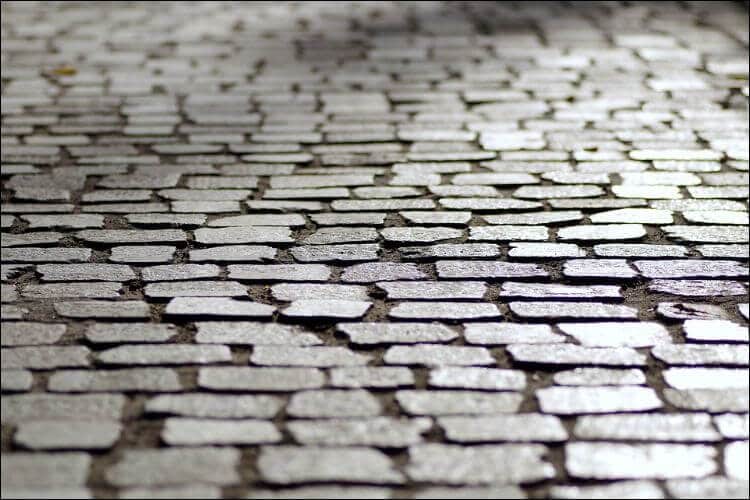
Pavers can create paths, patios, borders and patterned focal points. Choose the design and paving system together: a pedestrian path, vehicle area and permeable pavement do not necessarily use the same base, joints or drainage details.

Plan the installation before choosing a pattern
1. Compare the complete cost
Include excavation, spoil removal, base materials, drainage, edge restraints, cutting and labor as well as the pavers. Individual units can often be replaced, but good performance depends on the layers beneath them. Installation is not automatically an easy weekend job.
2. Establish excavation and utility requirements
Have underground utilities located before digging and account for private lines that a public locate may not cover. In the United States, start with 811. The required excavation depth depends on the paving system, ground, climate and expected loads; six inches is not a universal specification. Avoid damaging tree roots or altering drainage without assessment.
3. Specify the base and any geotextile
Use the chosen system’s installation details for subgrade preparation, aggregate base, bedding and compaction. A separation geotextile may be appropriate for particular soils, but generic landscape fabric is not a universal weed barrier or structural substitute. Do not interchange compacted base material and bedding sand.
4. Design drainage
A finished paved surface should be even without trapping water. Establish the required fall and a lawful outlet before setting elevations; protect building thresholds and avoid directing runoff onto neighboring property. Permeable paving requires a complete infiltration or drainage design, not just wider gaps.
5. Restrain the edges
Use edge restraints specified for the system and its loads. Decorative border units alone may not stop movement. Plan around curves, beds and existing structures so the edge detail remains continuous.
6. Lay out colors and cuts
Dry-lay a sample area to compare patterns and colors. A single color can create a calm design; blended shades are optional. Where the supplier recommends mixing units from several packs, do so to distribute normal color variation. Design the layout to avoid unnecessary sliver cuts.
7. Cut with dust control
Use equipment and dust controls appropriate to the paving material, following tool instructions. Concrete and stone cutting can create hazardous silica dust. Keep bystanders clear and use the required protective equipment rather than dry-cutting casually in the garden.
8. Fill joints as specified
Choose compatible jointing material and follow its installation and curing requirements. More sand is not automatically better, and ordinary sand joints do not make a patio permeable. Do not wash excess jointing products into drains or beds.
9. Keep spare units
Retain a modest quantity from the same batch for repairs, plus the product name and installation details. Store them securely so replacements can be matched later.
10. Inspect and maintain
Check for settlement, spreading joints, loose edges and drainage problems. Correct the underlying cause before resetting units. Weeds can establish in material deposited in joints even when the original base was well prepared.
The Concrete Masonry & Hardscapes Association installation guidance explains the importance of specified base, bedding and placement. Use the product-specific design and local requirements for your project.
Landscaping with Pavers – Design Suggestions
Now that you know a thing or two about landscaping with pavers, it’s time to have a look at some design ideas. How can you integrate pavers in your landscaping design? Check out these original ideas.
1. Place them around a Fountain
If you happen to have a fountain in your backyard, it’s a good idea to fill the space around it with pavers. Add a personal touch and get some that are slightly colored for a more interesting effect. Combine various sizes to make it look more natural. Just as we mentioned above, if you decide to cut them differently, make sure they fit in together.
2. Blocks of Stone
Another original idea if you want to have a unique design of your patio or backyard is to go for huge pavers. Use blocks of stone and create a pathway out of them. The monolithic stones will make a great combination with stone dust set around them. If you think this idea is too harsh, you can try adding some colorful flowers or some greenery around it.

3. Use them to Connect Areas
Get some inspiration for landscaping with pavers and use this idea of connecting different areas through them. For example, if you want to include a unifying element all over your outdoor space, choose the same paver pattern. One option is to use pavers with a cobblestone effect and connect your pool deck to the bar and the fire pit, for instance.
4. Combine them with Bricks
When landscaping with pavers, you don’t need to exclude bricks from your arrangement. Try to mix some stone pavers with them. For example, if you have a bunch of stairs, you can use bricks on them, and leave stone pavers only on the upper side of the steps. The gray shade will contrast nicely with the reddish hue of the bricks. Moreover, you can complete the design by adding pavers in other parts of the patio as well, for a homogeneous look.
5. Circular Design
One of the most appreciated advantages of pavers is the fact that they are versatile. You can play around with their shape, colors, anything. As such, you can let your imagination take control and create a round shape. Circular designs can suit a huge array of patios and backyards, so there should be no problem in integrating it. Set it around a fire pit, a fountain or a round pool, for instance. Choose units rated for the intended use and exposure. Of course, you can use other shapes as well, if you want to, such as a hexagon, diamond, etc.
6. Party Patio
Just like we were saying earlier, pavers are great for unifying different areas. If you’re hosting parties often at your place, you might want to consider having a party patio with pavers. The entire area should encircle the barbecue, fire pit, pool, bar, etc. Choose different colors if you want to have a more creative outdoor space. Optionally, you can also add a modular block wall that frames the pavers area.
7. Creating a Focal Point
If you’re previously arranged a patio, then you must know about the need of a focal point. The focal point can be a fountain, a fire pit, or simply an area where you place lounge chairs in a circle. Landscaping with pavers is a great choice if you want to have a solid base around a fire pit, for example. Use only materials and clearances approved for the particular fire feature. Ordinary paving units are not automatically suitable for direct flame or high heat, and freeze-thaw performance depends on the product and installation. However, it might be hard to clear ice and snow off it, so pay attention to that. Alternatively, you can also use some landscaping ideas with gravel if you want to include them all.
8. Pavers and Soil
One of our original ideas for landscaping with pavers is to quit placing them one next to another. Instead, place them here and there on the ground. A light color of the pavers would contrast nicely with the dark color of the ground, which is great. The downside here would be that they might get very dirty when it rains. If you’re bothered by this, you can replace the dirt with stone dust or sand.
9. Pavers and Grass
Yet another one of the winning combinations when it comes to including pavers in your patio design this year is combining them with grass. Just like in the previous example, you need to place the pavers a couple of inches apart. Then, use grass in between them. The final effect will be an exquisite one, combining different natural elements. If you want less maintenance, you can always opt for synthetic grass.
10. Black Stones
The last suggestion we have for landscaping with pavers is to include black stones in your design. They have an exquisite elegant look that complements the roughness of the pavers. You can either space out the pavers and place the black stones in between them, or you can set different areas for both. One option would be to create a walkway out of pavers and leave the rest of the space filled with the stones.

Conclusion
To sum up, it’s a great idea to consider landscaping with pavers for your own outdoor space. Pay attention to the tips and tricks we gave above and make sure your pavers will last. Finally, consider the suggestions we included and see which one fits your style better. Naturally, if you already have a certain design incorporated in your patio, you need to choose some pavers that match it. Luckily, there are plenty of creative ideas for every taste and arrangement. From a glamorous look with black stones to a natural one with grass or a geometric aspect, you can test your creativity by including pavers in your design.
Image source: 1