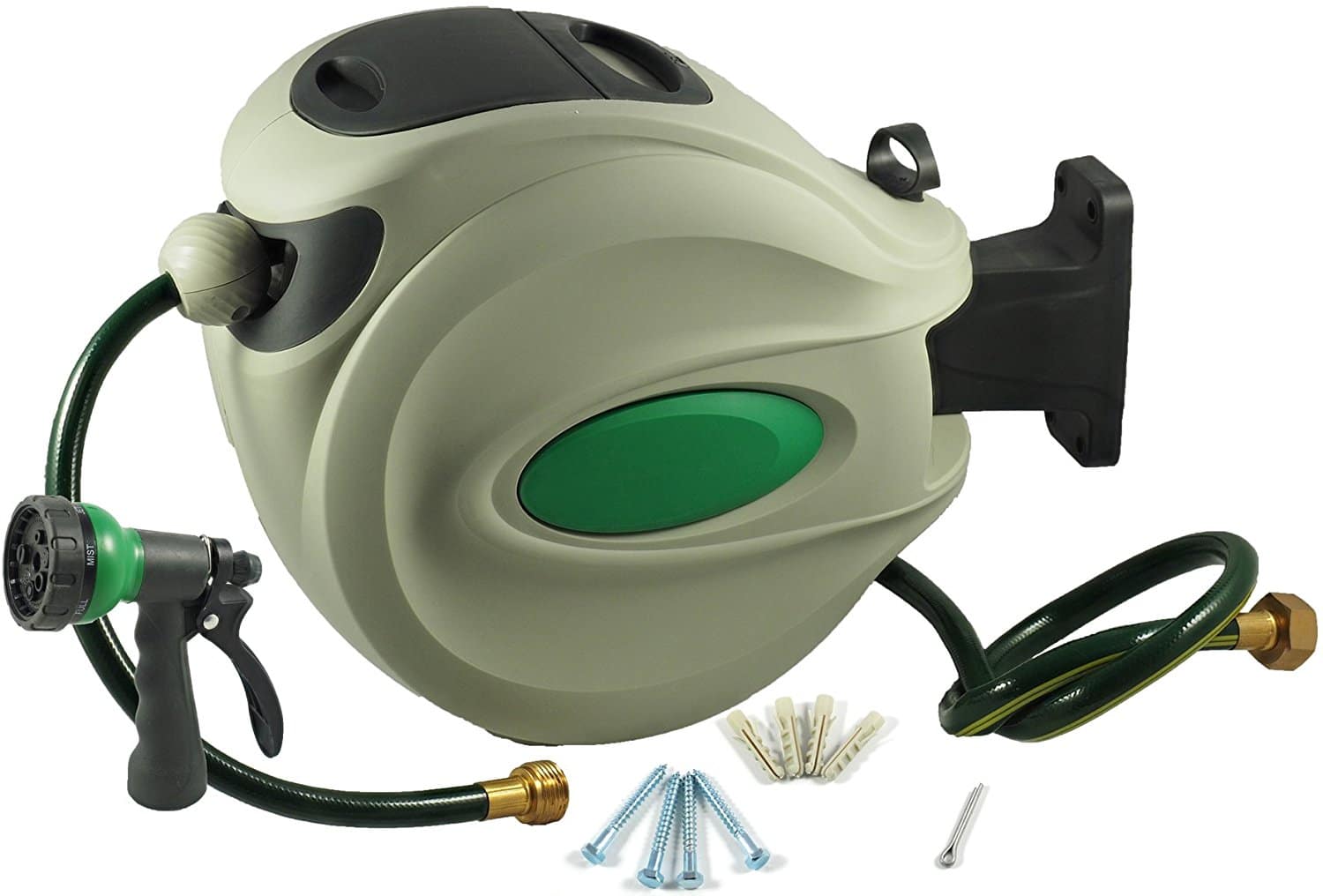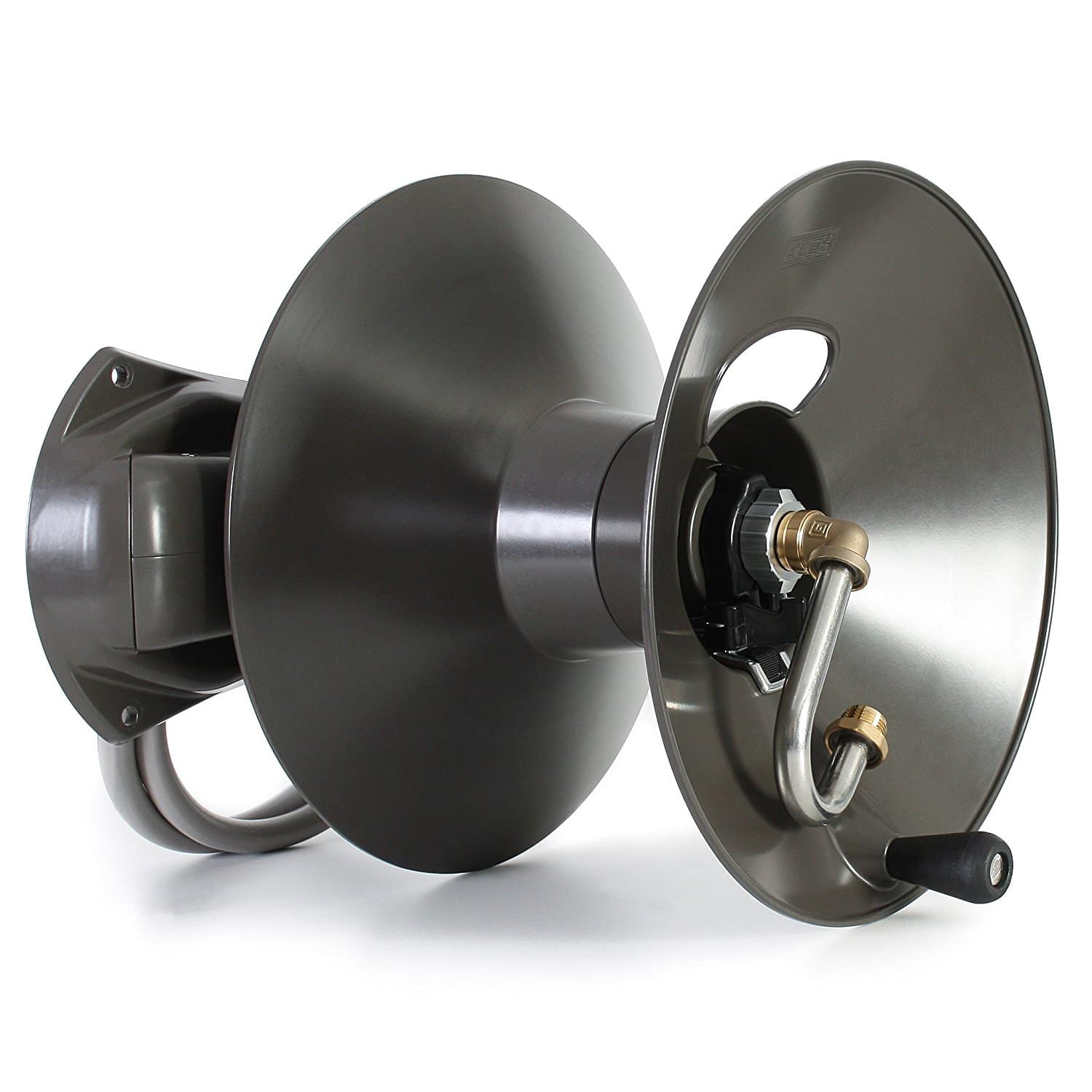
The Eley wall-mount hose reel, often found in older listings under the Rapid Reel name, is a manually operated reel for a fixed watering station. Model 1041 is the relevant starting point for this review. Its configurable mounting direction is useful, but the correct capacity, wall support and version-specific parts matter more than broad claims of lifetime savings.
What the current model includes
Eley’s model 1041 product page describes aluminum-alloy construction, lead-free brass components and a 6½-foot, 5/8-inch inlet hose. It offers standard and extra-capacity configurations. Check the selected package to establish whether a watering hose or capacity kit is included; a reel-only order is not a complete hose bundle.
The manufacturer states that capacities vary with hose brand and style. Do not apply an old 150-foot claim to every hose or confuse the standard reel with an expanded configuration. Use the current capacity chart for the hose diameter and configuration you intend to buy.
Choose parallel or perpendicular mounting
The reel can be assembled so the hose pulls alongside the wall or away from it. These are two configurations of the same model, not evidence of an automatic swiveling mechanism. Decide which route lets the hose reach your beds with fewer sharp turns and less contact with masonry or corners.
Allow space for the crank, your hand and the full wound hose. Also consider the leader hose’s path to the tap and whether a gate or door will hit the installed reel. Positioning the reel solely by its empty dimensions can leave too little room for convenient use.
Installation depends on the surface
Eley’s assembly guidance separates wood-frame, masonry and wood-post installations. The post arrangement uses an additional post kit. Match the instructions and hardware to the actual structure; do not assume one anchor or drill-bit size suits brick, hollow block, concrete and framed walls alike.
Cladding alone may not provide the necessary support. The installation must withstand the loaded reel and the pull on the hose. If you cannot identify sound fixing points, have the site assessed before drilling. Do not convert the wall reel into a floor stand or portable unit without manufacturer approval.
Winding and watering
This is a hand-crank reel, so it still requires you to gather and guide the hose. Straighten the route before winding, remove snags and distribute the hose across the drum. Cranking harder against a caught hose increases strain on the hose, swivel and mounting.
The reel does not increase the water pressure available at the nozzle. Hose length, diameter and the rest of the watering system affect delivery. Choose enough hose to reach the required area with some working slack, rather than filling the reel simply because space is available.
Leaks, warranty and older Rapid Reel units
Eley advertises a ten-year warranty on the current product. Read its terms for the unit and purchase you are considering; warranty coverage is not proof that every connection will remain leak-free in every installation. Shut off the water and release pressure before investigating a leak.
For an older Rapid Reel, identify the model and production version before requesting seals, an inlet hose or other parts. A current accessory’s resemblance to an older component is not enough to establish compatibility. Keep purchase information and the applicable manual with your maintenance records.
Who should consider it?
Model 1041 suits someone who wants a permanent manual reel and has a suitable mounting location. It is less convenient if the watering station must move frequently or if powered rewind is the main priority. This assessment is based on manufacturer documentation, not a hands-on comparative test. See our hose reel guide for the main format differences.