For an April wedding, choose flowers by your venue’s location and your florist’s actual supply, not the month alone. April is spring in much of the Northern Hemisphere and autumn in the Southern Hemisphere. Local outdoor bloom times also differ from flowers grown under cover or imported.
These eight options offer different shapes, colors and textures. Treat them as a discussion list for your florist, with an agreed substitute for anything that may be unavailable.
1. Orchids
Orchids can provide a clean, architectural look in a bouquet or centerpiece. Ask which species or cut stems the supplier expects to have, because “orchid” covers many different flowers and sizes. A cascading arrangement and a compact hand-tied bouquet may need very different stem structures.
Do not assume orchids are flowering locally outdoors in April. Confirm the source, color and handling plan, especially for a cool outdoor ceremony.
2. Peonies
Peonies provide a large, rounded focal flower, but April can be early for locally grown herbaceous peonies in many temperate regions. The RHS peony guide places their flowering in late spring and early summer. Warmer regions and commercial supply chains can differ.
If peonies are central to the design, ask whether the quote depends on imported stems and what happens if the desired color is unavailable. Agree on a replacement with a similar shape rather than relying on an exact outdoor flowering date.
3. Pink roses
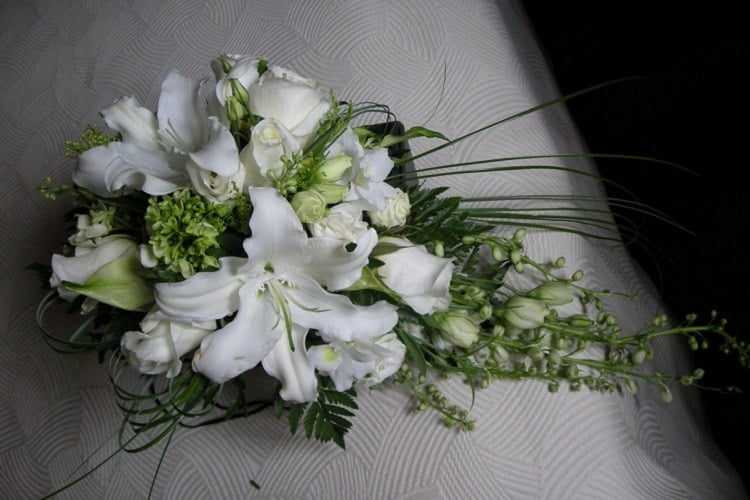
Pink roses suit a traditional bouquet, while mixing flower sizes or using looser foliage can make the arrangement more informal. Ask to see the actual shade: pale blush, warm peach-pink and cool pink can look quite different beside fabric swatches.
For an April event, confirm the florist’s supply rather than assuming garden roses in your area will be ready. If you like mixed textures, discuss a small succulent accent and its weight in a handheld bouquet.

Image source: Pixabay
4. Gerbera daisies
Gerberas offer a bold, daisy-shaped face in bright or softer colors. They can be the main feature of a simple bouquet or an accent repeated through table arrangements. Confirm stem support and vase choices with the florist so the heads sit where intended.
5. Tulips
Tulips are a strong spring-style option, with single, double and other flower forms. Their local season depends on climate and cultivar; the RHS tulip overview shows the variety available for spring displays.
Ask the florist how the chosen stems will be conditioned and arranged. If you are growing your own, do not make a single planting your only source for a fixed wedding date; weather can move flowering earlier or later.
6. Freesias
Freesias contribute smaller blooms and fragrance to an arrangement. Smell a sample before committing to them, especially for a bouquet held near the face or a centerpiece at a dining table. Choose color and scent intentionally rather than assuming every guest wants strongly fragrant flowers.
7. Sunflowers
Sunflowers suit a rustic or bright yellow palette, but they are not a dependable locally grown April crop in many cool climates. Confirm availability and head size with the supplier. A very large head can dominate a small bouquet or obscure guests’ view across a table.
8. Snapdragons
Snapdragons add upright lines and height, useful for a looser bouquet or a tall arrangement. Ask which stem length and colors will be available and whether locally grown stems are realistic for your region. Their role is different from a rounded focal flower such as a peony.
Questions to settle before ordering
- Which flowers are confirmed for the wedding’s date and location?
- Which will be local, grown under cover or imported?
- What substitutions are allowed, and which colors must remain consistent?
- How will flowers be stored, transported and kept hydrated before the ceremony?
- Does the venue restrict scent, loose petals or particular installation methods?
Build the design around a color palette and shape that can survive a substitution. That gives the florist room to use good-quality stems while keeping the overall look you chose.