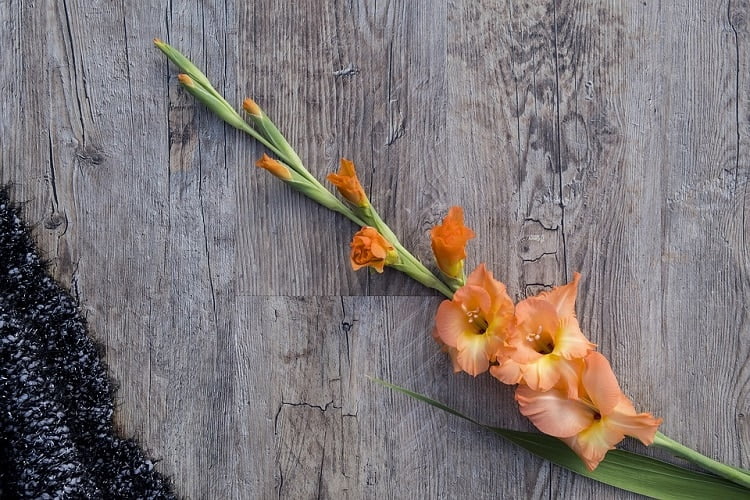
Gladiolus produces upright flower spikes for borders and bouquets. The usual large-flowered garden hybrids grow from corms planted in spring, with summer flowers following. Their care differs from dahlias, and winter hardiness varies among gladiolus species and cultivars.

Choose corms and a suitable variety
Shop by the named variety’s height, flower color, bloom season and hardiness. A larger, healthy corm of a given variety generally supports a better flower spike, but corm size alone does not identify a tall variety. Avoid soft, damaged or visibly diseased stock.
Large-flowered hybrids make dramatic cut flowers; smaller types fit more easily among other border plants. Ask the supplier whether your selection should be lifted for winter in your region. The RHS growing guide distinguishes tender garden hybrids from hardier types such as Gladiolus communis subsp. byzantinus.
Give them sun and drainage
Choose an open, sunny position with shelter from strong winds. Deep shade is not equivalent to full sun: it can weaken stems and reduce flowering. Leave space around the planting for air movement and access to cut flowers.
The soil should hold some moisture but drain freely. Do not describe suitable soil as one that retains no water. If the site stays soggy, use another location or a properly drained raised bed. A small addition of sand to a wet hole is not a dependable drainage repair.
Remove weeds and loosen the planting area without working it while saturated. Add finished compost where appropriate, and follow soil-test guidance for fertilizer. There is no requirement to raise every garden bed by an exact number of inches.
Plant corms at a consistent depth
Timing depends on the type of gladiolus and local spring weather. Avoid frozen or waterlogged soil, and protect emerging tender shoots from frost. A month suitable for one region may be too early or too late elsewhere.
- Arrange corms in groups for a border or rows for a cutting patch.
- For typical large-flowered garden hybrids, plant roughly 4–6 inches deep, adjusting for corm size and the supplier’s instructions.
- Space about 4–6 inches apart, or use the wider spacing recommended for the cultivar.
- Set the pointed end upward, cover with soil and water in.
- Install supports for tall varieties without piercing the corms. Label the variety and date.
These dimensions are a starting point for common garden hybrids, not a rule for every specialist species. Iowa State Extension’s tender-perennial guide gives additional planting guidance for gladiolus and other summer-flowering plants.
Stagger plantings for a longer cutting season
Planting smaller batches about two weeks apart can spread the display. Keep enough growing time before autumn cold for later batches to flower; do not keep planting indefinitely. Cultivar maturity and weather affect the interval from planting to bloom, so “exactly 90 days” is not a promise.
Record the first flowers from each batch. Those notes will be more useful for next year’s timing than a general calendar intended for a different climate.
Water, mulch and support as plants grow
Check soil moisture regularly and water during dry spells. Aim for a moist root zone without standing water. Container plants can dry faster than those in the ground. Avoid increasing irrigation merely because an old leaf is yellow; first inspect the soil and plant.
A suitable mulch helps reduce evaporation and weeds. Keep it away from the emerging shoots and pull weeds carefully so you do not damage shallow growth. Feed according to soil conditions and the product label rather than applying a fixed dose to every garden.
Tie taller spikes loosely to stakes, or use a suitable support mesh over a cutting bed. Inspect ties as stems lengthen and after windy weather.
Cut flowers while preserving leaves

For a vase, cut when the lowest flower on the spike begins to open, rather than waiting for the entire spike. The remaining buds can develop indoors. Use clean tools, put the stem into clean water promptly, and remove leaves that would sit below the waterline.
Leave at least three or four leaves on the plant to help develop next year’s corm, as advised by Iowa State Extension. Cutting in the cool part of the day can make handling easier. Refresh the vase water and remove fading florets.
In the garden, remove the spent flower spike when flowering ends, but retain healthy foliage. Deadheading does not turn gladiolus into a bushy plant or guarantee another spike that season.
Lift and store tender corms for winter
Where your variety is not winter-hardy, allow time after flowering for the leaves to replenish the corm, then lift before the ground freezes. Local extension guidance can help with the timing in your climate. Dig carefully to avoid cuts and bruises, and keep each variety labeled.
Cure the lifted corms in an airy, dry place before storage. Once dry, separate and discard the old shriveled corm beneath the new one, and set aside small cormlets if you want to grow them on. Store healthy stock in breathable containers in a cool, frost-free location and inspect it periodically.
The University of Minnesota’s storage guide emphasizes protecting tender underground structures and removing deteriorating material. Do not spray stored corms with an unspecified insecticide as a routine precaution.
Watch for problems
Inspect mottled flowers and leaves for thrips or other pests, and reject rotting corms. Distorted growth is not enough to identify the cause by itself. If a problem persists, bring clear photographs and the variety name to a local extension service rather than treating by guesswork. Good drainage, sound planting stock and keeping records are useful starting points.