Landscape timbers can give a yard a strong border and a rustic appearance, but decorative timber is not interchangeable with structural lumber. Match the wood, treatment, fasteners and design to the job. These nine ideas are starting points for planning, not construction specifications.
Choose the material first
Check the product’s intended exposure, including ground contact where relevant. A preservative-treatment rating addresses decay protection; it does not establish structural strength. American Wood Protection Association guidance explains wood-treatment categories.
Avoid assuming reclaimed railroad ties are suitable for every household project. Identify treatments and follow the material’s permitted uses and handling directions. Consult EPA’s creosote information when evaluating reclaimed treated wood. Do not burn treated offcuts.
1. A pergola with a timber appearance
A pergola can frame a seating area or walkway. Use a design specifying structural posts, beams, connections and foundations suitable for the loads and site. Decorative landscape timbers should not be substituted for specified members simply because their appearance matches.
Consider mature climbing-plant weight, wind and any future shade covering. A photograph cannot tell you the required footing or connection details.
2. Raised garden beds
Timber beds can define planting space and reduce bending. Select materials suitable for the intended planting and exposure, and use a bed design with appropriate corner connections and restraint.
Heavy timbers can move under soil pressure. Do not assume loosely stacked pieces are secure because of their weight. Plan bed width so you can reach the planting without stepping on the soil, and leave working space around it.
3. Retaining walls
A timber retaining wall can terrace a slope, but it holds back soil and water loads. Drainage, anchoring, foundations and nearby loads matter as much as the visible face. Seek local permit and design guidance before selecting materials.
Walls near buildings, steep slopes or other loaded areas may need professional design. Do not use a wall as seating unless it was designed for that use and the adjacent drop is safely addressed.
4. A wall or shed with timber cladding
Wood can create a consistent visual theme around a small outbuilding. Use a suitable building system for structural walls and add approved cladding where appropriate. Landscaping pieces are not automatically a substitute for framing.
Check moisture detailing, foundations and local building requirements. Keep the design simple enough to inspect and maintain.
5. A decorative screen
A screen can divide a seating area from a service corner without enclosing the whole yard. Open lattice and separate panels create different degrees of privacy.
Even a decorative panel catches wind, so use suitable posts, foundations and connections. Locate it without blocking sightlines, access or required clearances. It is not a substitute for a required safety barrier.
6. Timber accents near a pool
Use timber accents only where the materials and design suit the wet environment. Pool decking needs a suitable walking surface and structure; a landscape timber is not automatically a quick-drying, slip-resistant deck board.
Pool barriers and gates have safety requirements independent of appearance. Keep furniture and decorative features from creating climbing opportunities. Obtain appropriate design advice rather than copying an image of a low decorative fence.
7. Garden steps
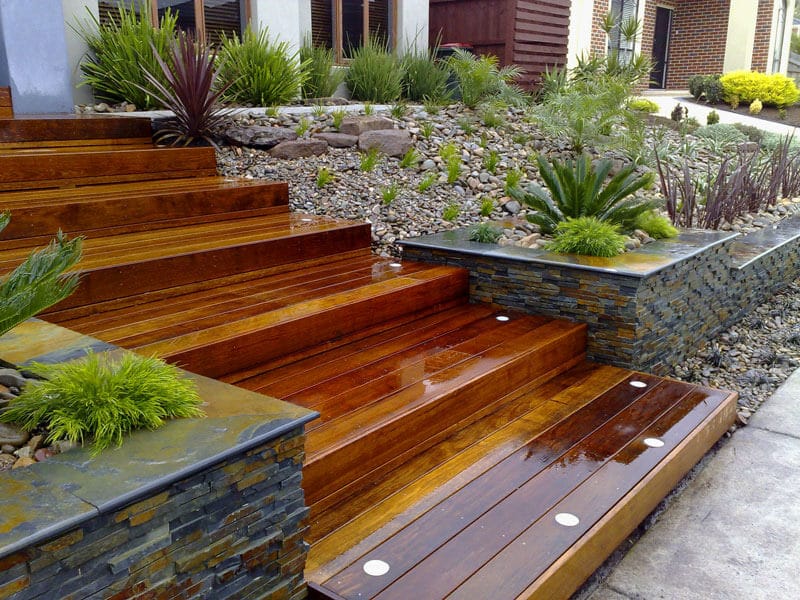
Timber risers with a suitable tread surface can suit a sloping garden. Steps need consistent geometry, stable foundations, drainage and any required handrails. Loose gravel is not appropriate for every user or slope.
Plan the entire run before construction. Do not improvise a series of frames and assume the resulting heights will be comfortable or safe.
8. Rustic furniture
A timber-style bench or table can complement planting beds. Use a furniture design and materials suitable for contact with people, including stable joints and smooth surfaces.
Do not turn unknown treated offcuts into children’s furniture simply because they are small. Rounded edges and a rustic finish do not establish safe construction.
9. Low landscape edging
Low edging is a useful way to outline a bed or separate loose materials. Use appropriate ground-contact material and secure it with a method suited to the product and site. Check for utilities before driving stakes.
Keep edges out of walking routes and plan mowing access. Compare the visual effect and maintenance with other landscape edging options before committing to a large border.
Start with a design you can build and maintain properly. The same timber look can be achieved in several ways, but each structure still needs materials and details appropriate to its purpose.
Image sources: 1