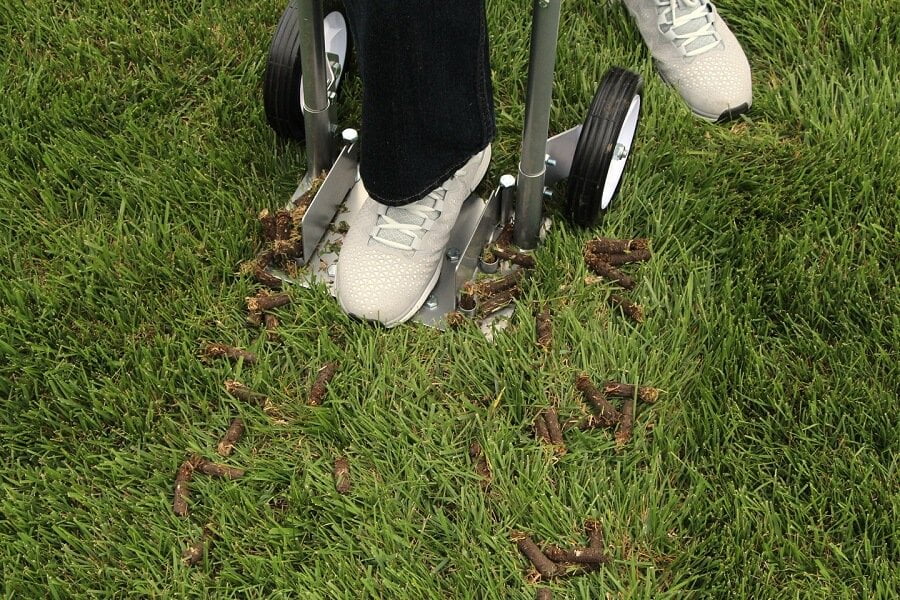
Core aeration can help a compacted lawn by removing small plugs of soil and creating openings for air and water. It is useful when compaction is limiting growth, but every lawn does not need treatment once or twice a year. Poor drainage, shade, disease or unsuitable grass may require a different solution.
What core aeration does
A hollow-tine aerator removes cores rather than merely pushing a spike into the ground. The openings help relieve compaction while the grass recovers and roots grow. A garden fork or spike shoe does not remove soil in the same way. Do not judge success by whether the lawn becomes unusually spongy; excessive thatch can itself be a problem.
Decide whether your lawn needs it
Repeated traffic, construction activity and use of wet ground can compact soil. Look at worn routes and areas where water does not infiltrate readily, then investigate the soil and roots. Standing water alone does not prove aeration will solve the problem: grading, a high water table or other drainage limitations may be responsible.
Consider reducing traffic or adding a path where the same route is continually worn. Aeration followed by the same damaging use may provide only temporary improvement. If a lawn is healthy and soil is not compacted, routine machine passes may be unnecessary.
Time it for recovery
Aerate when the grass is actively growing and can recover. For many cool-season lawns, late summer or early fall is preferred. Warm-season lawns are generally aerated in late spring or summer during active growth. The correct window depends on climate and grass species, not a universal April or May appointment.
Clemson’s turfgrass cultivation guidance distinguishes the two grass groups. Minnesota Extension’s spring guidance cautions against unnecessary spring aeration of its cool-season lawns. Avoid working dormant, drought-stressed, frozen or saturated turf.
Prepare for the machine
Use soil that is moist enough for the tines to penetrate but not muddy. Mark irrigation heads, shallow lines and other obstructions. Read the equipment instructions and keep people and pets clear during operation. A contractor can help if the machine, slopes or buried obstacles make the job unsuitable for you.
Follow local guidance and the machine’s settings for coverage. Leave extracted cores to break down unless your lawn-care plan calls for another approach. Aeration is not permission to apply fertilizer indiscriminately; base amendments on the grass, soil test and local rules.
Coordinate any seeding
If thinning areas also need seed, choose a compatible grass and an appropriate establishment window. Plan watering and check herbicide restrictions before sowing. Our new-lawn guide explains seed selection and early care.
Watch how the lawn responds over the following growing period. Improved infiltration and growth are useful outcomes; a guarantee of a soft, perfect summer lawn is not.