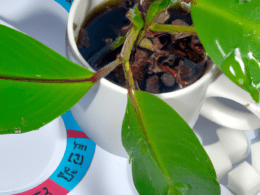
Keep a poinsettia in bright light, water when the potting surface begins to dry, and let excess water drain away. You can keep it as a green houseplant after the holiday color fades. Getting colored bracts again requires a consistent autumn light-and-dark schedule as well as healthy growth through the year.
Understand the plant’s seasonal display
The red, pink or white parts are bracts: modified leaves surrounding the small flowers. Fading bracts do not necessarily mean the whole plant is dying. Judge its condition by the stems, remaining foliage, roots and growing conditions rather than expecting the holiday display to last unchanged.

Choose a plant with firm stems and healthy foliage, and protect it from cold on the trip home. Do not leave it in a parked car during freezing weather. Once indoors, remove tight transport wrapping and find a stable growing spot.
Light and temperature indoors
A bright window is useful, but keep foliage away from cold glass and avoid a position beside a heater or a frequently opened exterior door. University of Minnesota Extension recommends indoor temperatures around 65–70°F and warns that temperatures below 50°F can cause damage. Avoid abrupt changes in exposure and temperature.
Bright, indirect light is a practical starting point for a holiday plant. Check the actual location: a room that seems bright to you may have a much darker corner behind furniture. Conversely, a hot window can dry a small pot quickly. Move the plant if foliage is exposed to excessive heat or drafts.
Water by the soil, not the calendar
Feel the potting surface and lift the pot to learn how it feels as it dries. When the surface is dry to a light touch or the pot feels light, water thoroughly and allow it to drain. Do not wait for repeated severe wilting, and do not keep adding water to a pot that is still wet.
Remove decorative foil or the outer container before watering. Empty any water collected beneath the pot before returning it to display. Drainage holes are essential: attractive wrapping must not turn the container into a reservoir around the roots.
The interval changes with pot size, heat, light and plant growth. Daily watering is not a universal requirement. If leaves droop while the soil is wet, inspect drainage and growing conditions instead of automatically watering again.
Feeding and spring growth
Fertilizer is not needed simply to maintain the holiday display. Once active new growth appears, use a houseplant fertilizer according to its label and extension guidance. Do not try to correct a waterlogged or severely stressed plant with extra fertilizer.
After the display fades, keep providing suitable light and moisture. There is no requirement to abandon the plant in a dark garage. Remove dead material and inspect for pests before moving it among other houseplants.
Spring pruning can encourage a more compact shape. Use clean tools and make cuts on healthy stems, retaining viable growth points. Wear gloves if the sap irritates your skin. Repot when needed for root space or deteriorated potting mix, using a container with drainage and an appropriate houseplant mix; a much larger pot can stay wet longer than expected.
Summer care
In a temperate climate, move the plant outdoors only after frost risk has passed and nights are reliably warm. Acclimate it gradually in a sheltered position rather than putting indoor-grown foliage straight into intense sun. Check watering more frequently as conditions change, while continuing to let the pot drain.
Pinching growing tips can encourage branching during the growing season. Stop late-season pruning in time for the autumn display cycle. Bring the plant indoors before chilly nights, checking leaves and stems for insects first. Local weather is more useful than a fixed instruction to move it outside every June or inside on one holiday.
How to encourage colored bracts again
University of Maryland Extension describes a schedule of 14 uninterrupted hours of darkness and 10 hours of daytime light, starting around the beginning of October for a winter holiday display. One workable timetable is darkness from 5 p.m. to 7 a.m. This is a temperate Northern Hemisphere schedule; adjust seasonal planning elsewhere.
During the dark interval, use a genuinely dark room or a suitable opaque cover. Ordinary room lights, hallway light or a frequently opened cupboard can interrupt the treatment. During the day, return the plant to bright light. A box left on continuously deprives it of the daytime light needed for healthy growth.
Continue normal moisture checks and keep conditions stable through the several-week treatment. Cultivar and conditions affect timing, so color is not guaranteed on an exact date. Once the bracts have developed their display, return the plant to its ordinary bright location. Keeping it as a healthy green plant is also a reasonable choice if daily blackout care is impractical.
Common problems to check
- Leaf drop: review cold exposure, drafts and changes in watering before assuming fertilizer is missing.
- Wet soil and wilting: empty the outer pot and check drainage; additional water may worsen the problem.
- Long, sparse growth: review light and consider pruning during the appropriate growing period.
- No autumn color: check whether the dark interval has been consistent and truly uninterrupted.
Children, pets and sap
Poinsettias have an exaggerated reputation for deadly poisoning, but “harmless to eat” is also the wrong message. Poison Control explains that chewing the plant can cause mouth irritation or stomach upset and its sap can cause a rash. Keep it out of reach of children and pets, avoid sap contact with eyes and mouth, and wash after handling. For an exposure, contact a poison center or veterinarian as appropriate.
Images source: depositphotos.com.