The best fabric for outdoor furniture depends on the job. A cushion cover needs comfort and appropriate weather performance; a sling chair needs fabric engineered to support a person within that chair’s design. “Outdoor fabric” is not a guarantee that one material can do both.
Start with where the furniture sits, how often it gets wet, how much sun it receives and whether cushions can be stored. Then compare the specific fabric’s technical and cleaning information rather than choosing by fiber name alone.
Cushion covers and slings need different specifications
A cushion cover rests over a filling supported by the furniture. A sling spans a frame under tension and is part of the load-bearing seating system. Ordinary canvas or decorative upholstery should not be substituted for a sling simply because it feels strong.
Phifer distinguishes sling fabrics from other outdoor applications. For replacement slings, use a fabric and construction compatible with the chair manufacturer’s requirements, including attachment and sizing. Have a suitable professional do the work if the assembly is uncertain.
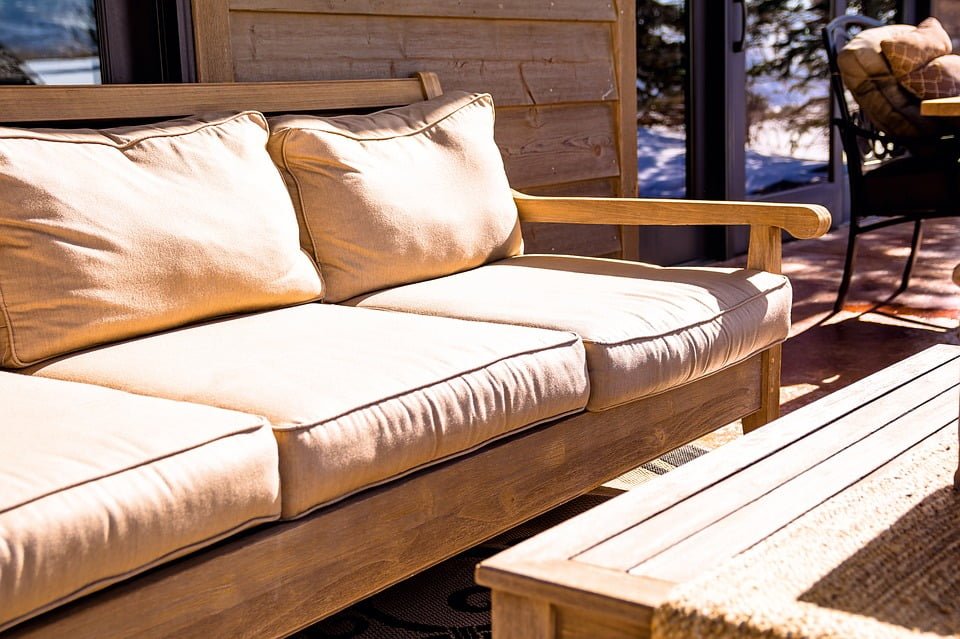
For cushions, consider the entire construction: filling, seams, closures and drying arrangements. A water-resistant cover does not guarantee that the cushion inside remains dry during prolonged rain.
Cotton canvas and duck cloth
Canvas and duck describe fabric constructions; they are not automatically certifications for exposed outdoor use. Cotton versions can be useful for sheltered, removable items when their care and expected exposure are understood. They can absorb water and require attention to drying and storage.
A protective spray does not turn every cotton fabric into a durable, waterproof, UV-resistant upholstery product. Check compatibility before applying a treatment, and do not assume that paint improves flexibility, cleanability or seating performance.
Ask for the actual fiber content, outdoor-use specification and care instructions. Price and availability vary, so avoid choosing on the assumption that canvas is always the cheapest suitable option or duck always performs better.
Olefin for cushions and other specified uses
Olefin is a synthetic fiber used in outdoor fabrics, including softer upholstery. Phifer’s material guide describes its own olefin and blended product applications. Look at the particular fabric rather than treating all olefin as identical.
Water resistance, colorfastness and comfort depend on the product and construction. Do not describe it as immune to heat, mold or every outdoor condition. Dirt and moisture still need management, and a cushion should not be stored wet merely because its cover is synthetic.
Request a sample if feel is important. Compare it in the intended light and against other materials on the furniture rather than assuming that every synthetic fabric feels like rigid plastic.
Solution-dyed acrylic and other performance upholstery
Solution-dyed acrylic is another option for outdoor cushions. Sunbrella describes the construction and intended performance of its acrylic upholstery. That is manufacturer information about identified products, not a claim that every acrylic fabric has the same specifications.
Compare resistance to fading, abrasion, stains and water, along with the actual warranty terms. A fabric can resist brief wetting without being waterproof. Sunbrella itself distinguishes products with different water performance.
Polyester products also vary in coatings, construction and intended use. Avoid ranking an entire fiber family as always superior without comparing equivalent products for the same application.
Coated mesh and TEXTILENE
Twitchell identifies TEXTILENE as a PVC-coated polyester product family. Coated mesh is often associated with outdoor seating and shade applications, but the precise fabric still needs to match the intended job.
Do not assume that every mesh is sling-rated, waterproof or flame retardant. Shade cloth and seating fabric are not interchangeable just because their appearance is similar. Where fire-performance requirements apply, obtain documentation for the exact product and use; a generic brand or material name is insufficient.
Check care before you buy
Read the cleaning directions for the exact fabric and the finished furniture. Bleach, solvents, machine washing and high-pressure cleaning are not universally acceptable. Remove debris, address spills as directed and allow items to dry before storage.
Sunbrella’s care information notes that dirt and debris can support mold or mildew even on resistant fabrics. Resistance reduces a problem; it does not remove the need for maintenance.
Before ordering, confirm the use, dimensions, pattern repeat, sewing requirements, cleaning method and replacement availability. Keep the product identification and care sheet with the furniture records. The strongest choice is the fabric that fits the seating design and the care you can realistically provide.