Indoor hyacinths need bright light, careful watering and a reasonably cool display position. If you already have a flowering plant, focus on maintaining it; if you are starting a dormant bulb, it first needs the preparation and rooting period appropriate to that bulb. These are different stages, not a reason to move a rooted bulb repeatedly between soil and water.
Start by checking what you bought

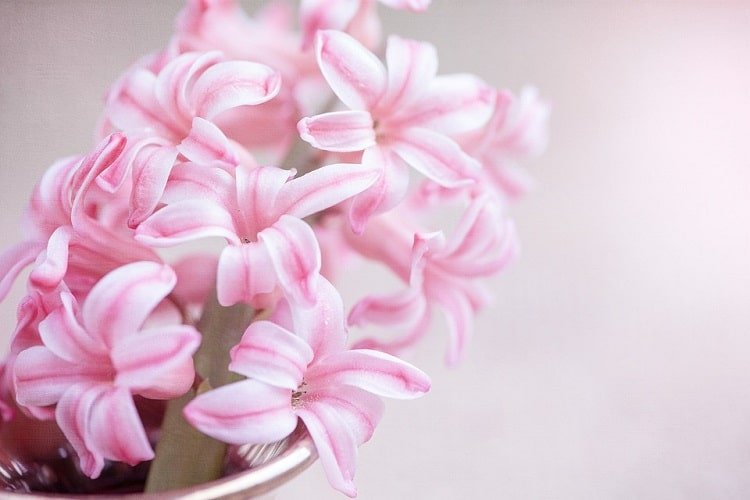
A flowering gift pot, a prepared bulb for an early display and an ordinary outdoor bulb are not interchangeable starting points. Keep the supplier’s instructions and cultivar label. The word “prepared” can refer to a treatment for early flowering, so ask what cold or rooting period remains instead of assuming every package has already completed it. Image credit: Pixabay.
Wear gloves if handling bulbs irritates your skin, and keep bulbs and plants away from people or animals likely to eat them. RHS hyacinth guidance notes skin irritation and harm if eaten. These ornamental bulbs are not food.
Caring for a pot that is already growing
Give it a bright position away from radiators and other strong heat sources. A cool display generally lasts better than a hot room. Rotate the pot occasionally if growth leans toward a window, and keep it on a stable surface where a heavy flower spike will not pull it over.
Check the potting medium before watering. Keep it suitably moist during active growth without leaving the bulb in saturated compost. Empty a decorative outer container after watering so that the inner pot does not stand in runoff. A pot hidden inside foil or a cachepot still needs a way for excess water to escape.
Starting bulbs in potting mix
Use a clean pot with drainage and an appropriate potting mix. Set the bulbs upright, with their tips above the mix for indoor forcing, leaving watering space below the rim. Do not damage the basal plate by forcing a bulb into compacted material.
Iowa State’s forcing guide describes 12–15 weeks at 40–45°F for unchilled spring bulbs, followed by a gradual move into brighter, warmer conditions. Keep chilling bulbs away from ripening fruit. A shoot appearing does not by itself prove that the cold requirement is complete. Follow the supplier’s remaining schedule for pretreated bulbs.
Label the planting and chilling dates. This is more useful than promising flowers after four weeks regardless of the starting material. Once the required treatment is complete, allow time for the plant to develop; do not try to rush it by placing it beside a heater.
Using a hyacinth glass

A forcing vase supports the bulb above a water reservoir while roots grow down. Start with a suitable pre-chilled or prepared bulb and follow its instructions. Keep the water just below the bulb’s base, never with the bulb sitting in water. Check the level regularly and replace cloudy water carefully without damaging the roots. Image credit: Pixabay.
Do not uproot a healthy soil-grown plant simply to transfer it into a vase. Choose the growing method at the start. The RHS growing guide says water-grown hyacinths do not require feeding; adding fertilizer to the vase is not a way to guarantee longer flowering.
After the flowers fade
Remove the spent flower stalk and retain healthy leaves if you intend to save the bulb. Continue appropriate care while the foliage remains active, then reduce watering as it naturally dies down. For soil-grown plants, follow container-feeding guidance and the fertilizer label rather than treating a vase of water as a pot of compost.
Repeat indoor forcing is unreliable. Fresh bulbs are the more predictable option for a timed indoor display, but that does not mean every forced bulb is incapable of flowering again. RHS guidance allows trying healthy bulbs in a suitable garden site; water-forced bulbs are often discarded and future performance varies. Do not promise a matching flower spike next year.
Troubleshooting without unnecessary treatments
If the plant wilts, inspect moisture and the bulb’s condition before adding water. A soft, rotten bulb cannot be restored merely by reducing watering. Isolate a suspect plant and seek a diagnosis when the cause is unclear. Do not spray leaves with alcohol or apply an unspecified fungicide because a surface looks mouldy.
A leaning stalk may need gentle support, but avoid pushing a stake through the bulb. If flowering is poor, review the bulb quality, preparation, temperature and light history. Fertilizer cannot replace a missed cold period or make a finished flower spike bloom continuously.