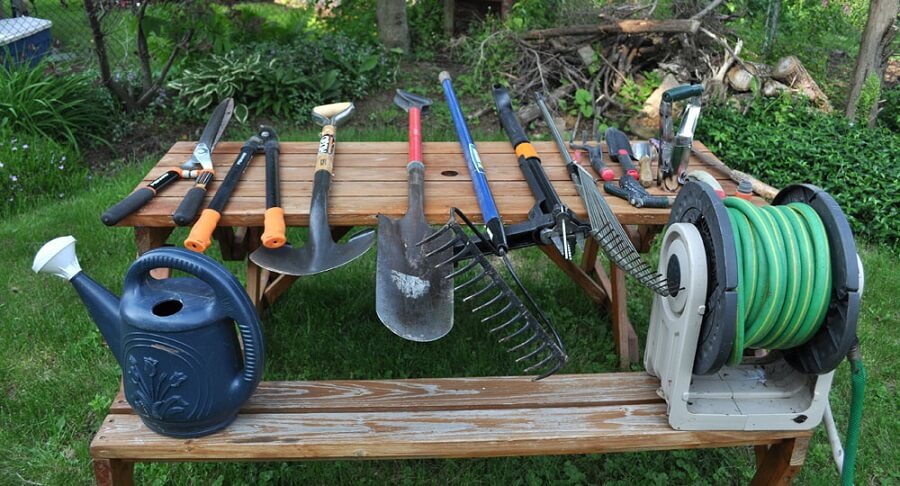
For a small first garden, start with gloves, a hand trowel, a suitable watering tool and a way to snip soft stems. Add larger tools when the work calls for them. A few patio pots do not require the same kit as a new vegetable bed or a yard full of shrubs.
Before shopping, list your first three jobs: filling pots, planting seedlings, clearing leaves, removing weeds or pruning an established plant. Check what you already own and can borrow. Hold tools before buying when possible; a comfortable grip and manageable weight matter more than collecting a matching set.

Gloves that fit the work
Choose gloves that let you grip a tool without bunching at the fingertips. Light washable gloves suit many potting jobs; tougher gloves may be useful around rough stems. No ordinary garden glove guarantees protection against thorns, bites or every chemical. Follow a product label when specialized protection is needed, and wash your hands after gardening.
No products found.
A hand trowel for pots and planting holes
A trowel is useful for moving potting mix, planting small transplants and working in tight spaces. Look for a secure connection between the blade and handle. A narrow blade helps between existing plants, while a wider one moves more loose mix. Avoid using a small trowel as a lever against buried rocks; choose a tool made for the resistance you meet.
Scissors and hand pruners
Scissors or garden snips handle twine and soft stems. Hand pruners are a better choice for appropriate woody stems. Match the tool to its rated cutting capacity and the plant’s pruning needs; a tool list cannot tell you when a particular shrub should be cut. Keep cutting tools clean, sharp and closed or sheathed in storage.
No products found.
A watering can, hose and gentle nozzle
For a few pots, a watering can you can comfortably carry may be enough. For beds farther from the tap, measure the route before buying a hose, including the distance around obstacles. Check fittings and storage space. A coiled hose can save room, but its reach and tendency to pull back depend on the design.
A rose, water breaker or adjustable shower nozzle spreads the flow so it is easier to water without blasting mix from a pot. It does not increase your water supply or cure low pressure. Choose a setting suited to the plant and direct water toward the growing medium. Store the hose so it does not cross a walking route.
No products found.
A hand weeder or small cultivator
A narrow weeder helps loosen a weed near its roots. A small claw-like cultivator loosens surface soil; it is not a leaf rake. Identify what you are removing before digging among seedlings. Avoid deep disturbance close to desirable roots, and remember that leaving pieces of some perennial weeds can allow regrowth.
No products found.
A leaf rake for light debris
A flexible leaf rake gathers leaves and light debris from a lawn or open bed. A small hand rake reaches around plants. Compare the head width with the space you need to work in; the widest rake is not necessarily the easiest to steer through a planted border.
No products found.
A bow rake for preparing a bed
A rigid bow rake is useful for spreading loose material and smoothing a prepared soil surface. Its stiff teeth do different work from a flexible leaf rake. Skip this purchase if you only grow in pots. Raking also cannot correct a site’s drainage or replace the preparation needed for a new lawn.
No products found.
A shovel or spade for larger digging jobs
A shovel commonly has a scooped blade for moving material, while a digging spade commonly has a flatter blade and straighter edge. Names and blade designs vary, so inspect the actual tool. Match blade shape and handle length to digging, edging or moving loose soil. Check for underground utilities before starting new excavation.
No products found.
A wheelbarrow, cart or carrying tub
Moving compost, bags of mix and trimmings is easier with transport suited to your route. A tub may be enough for a balcony; a cart or wheelbarrow becomes useful for a larger yard. Measure gates, steps and storage space, and choose loads you can control. Wet soil can be much heavier than a container of dry leaves.
Optional cutting tools for established gardens
Hedge shears suit shearing work, not every pruning job. Loppers provide leverage for branches within their stated capacity. Do not force a small cutting tool through a large branch or assume a universal branch diameter applies to every model. Overhead branches, ladders and nearby power lines require a separate safety assessment.
No products found.
No products found.
A hori-hori garden knife can combine small digging and cutting tasks, but it is optional rather than a beginner requirement. Its sharp edge needs careful handling and a sheath. A trowel and weeder may already cover the jobs you need.
No products found.
Add a hoe or pruning saw only for a defined job
A loop or stirrup hoe can cut young weeds just below the soil surface in an open bed. Keep shallow work away from desirable roots and irrigation lines. It is less useful in a tightly planted container, and it does not guarantee removal of established perennial weeds.
A pruning saw can handle an appropriate branch beyond the capacity of hand pruners. Choose a manageable model and follow its instructions; a folding blade needs a secure lock and protected storage. Overhead work, unstable limbs and branches near utilities call for qualified help. Do not assume ordinary hand pruners cut two-inch branches just because a tool list says so.
Plan purchases around seasonal tasks
Before spring planting, check handles, blades and watering equipment. During active growth, keep frequently used snips and watering tools accessible. When leaves fall, choose a rake or carrying tub suited to the space, then clean and dry tools before longer storage.
Seasonal needs depend on your climate and planting. You do not need a different complete kit for every season. A kneeling pad can improve comfort for ground-level jobs, and a bright handle can make a small tool easier to find. These are useful additions when they solve a problem, not requirements for every gardener.
Build the kit one job at a time
After your first few sessions, note which task was awkward and which tool would solve it. Clean off soil, dry tools before storing and inspect loose handles or damaged blades. Keep sharp tools and garden products away from children. For help choosing what to learn first, use our beginner gardening resource guide.
Image Source: here.
Last update on 2026-10-22 at 19:37 / Affiliate links / Images from Amazon Product Advertising API