By Robin Hortin via Fix.com – Backyard Fire Pit
From the earliest of times, people have communed around the campfire, telling tales and sharing personal stories. Gathering around the fire brings us together, and a backyard fire pit is the perfect spot to kick back and relax.
Backyard Fire pits provide ambiance, warmth, light, and a place to gather and entertain. It’s no wonder that they are high on homeowners’ wish lists. Basking in the glow of a beautiful fire can be romantic – enough that you might just opt for a staycation to watch those sparks fly.
You have a number of great choices to consider, so let’s start at the beginning. Ready to get fired up?
1. Have a Plan
What is your particular lifestyle and what kind of experience are you looking to create? Maybe you’d like to designate a social gathering area, making the fire pit the visual or decorative focal point of your outdoor living space. You might want to use the fire pit to warm up chilly evenings and extend your outdoor season. Perhaps you’d like to relive your childhood camp days by roasting hot dogs and making S’mores over the fire. No matter what you decide, you need to have a plan.
2. Pick a Location
Once you’ve determined how you’d like to incorporate a backyard fire pit into your outdoor living plan, the next step is to select its location. Evaluate your space. There’s a fire pit for every space, large or small. If you have a large piece of property, designate a section of land for the fire pit, but make sure to select a safe and convenient location.
Check local fire rules, current burn restrictions and property requirements before choosing the location. Follow the appliance or kit instructions for the supporting surface and all clearances, using the greater applicable requirement. The U.S. Fire Administration advises keeping fire pits at least 10 feet from homes and combustible materials; this is not universal permission to build any fire at that distance. Leave comfortable circulation around seating, and account for wind, smoke, vegetation and overhead obstructions.

3. Choose a Style: Custom, Prefab, or Portable
Backyard Fire pits can be permanent – either custom-built, or if you are handy, DIY – or you may opt for a prefabricated, ready-to-install fire pit that will be a permanent fixture. If you have limited space or want to take it with you when you move, a portable fire pit is a good choice. All these options come in many shapes, sizes, materials, and styles. The options are seemingly endless – what you choose will depend on your taste, available space, the location you’ve selected, and your budget.

Fueling the Fire
If you enjoy the scent of burning wood, a wood-burning fire pit is for you. If you are looking for one that is easy to use and clean, you might consider a gas-fueled fire pit. A fixed natural-gas installation needs an appropriately qualified installer and any required permits. Some manufactured propane models use a cylinder instead. Use only the fuel specified for the complete appliance. Do not improvise gas plumbing or use an open bowl of liquid fuel as a substitute fire pit.
Permanent Inground and Aboveground Fire Pits
Recessed fire pits are typically round, and they provide a natural ambiance with flames rising up out of the ground. They can also be less safe because it’s easier to stumble into them, which is something to consider, especially if young children will be around.
Aboveground fire pits are generally square, rectangular, or round. They can be simple or more elaborate. If you choose to construct a permanent in-ground or aboveground fire pit, use an engineered fire-pit kit or professionally specified assembly. Noncombustible does not mean every concrete block, brick or garden stone is suitable for direct fire exposure. The design must specify the firebox or liner, supporting base, drainage and any ventilation; an arbitrary metal ring does not validate the rest of the construction.
Whether you purchase an aboveground fire pit, custom build one, or go the DIY route, you have many design and materials options from which to choose. Commercially available designs are available in cast-fiber concrete, brushed stainless steel, carbon steel, and other synthetic composites.
Think creatively and multi-functionally. Buy or create a coffee table with an inset fire pit or one with a bench surrounding it for seating. Multitasking designs are great for smaller spaces because they function as both furniture and a fire pit.
Portable Options
Metal fire bowls are available in many sizes. Some have legs, and some can be placed directly on the ground. On the style front, prefab fire pits run the gamut from very traditional to sleek, ultra-contemporary designs. Some fire pits are like sculptures that provide a focal point for your outdoor space.
4. DIY: How to Build a Backyard Fire Pit
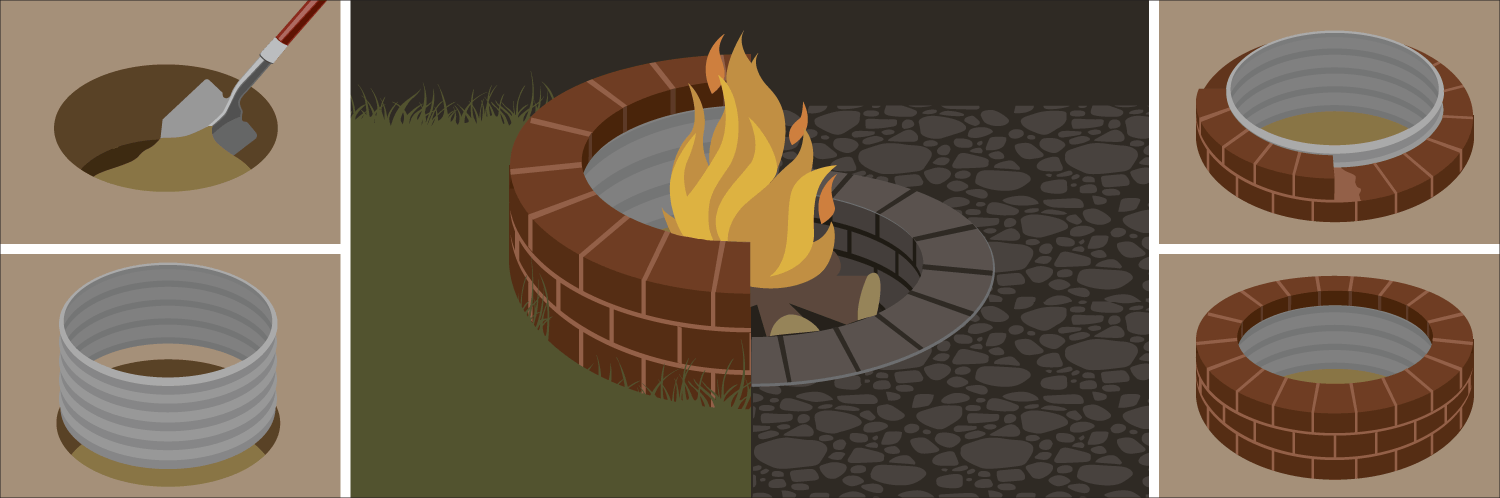
For a DIY project, choose a purpose-built kit with complete installation instructions and confirm that its use is permitted at your site. The illustrations below are historical design references, not a substitute for the kit specifications. Do not infer safe dimensions or materials from a picture.

Plan and assemble the specified system
- Obtain the kit manual, site permissions and any required utility-location service before digging.
- Mark the complete footprint, including clearance and seating areas. Check access and drainage before ordering materials.
- Prepare the base to the design’s stated excavation, compaction and leveling requirements. Avoid unsupported universal depth instructions.
- Assemble the specified blocks, liner and other components in the stated order. Use only approved bonding materials and allow any required curing time.
- Check stability, clearances and operation against the manual before the first fire. Have permitted utility work completed by a qualified professional.
Budget for base materials, drainage, delivery and disposal as well as the visible surround. If the site cannot accommodate the required assembly, select a different location or a flame-free feature.
5. Safely Enjoying Your Fire Pit
Use only a supporting surface permitted by the design or appliance instructions. Concrete, pavers and bare soil are not interchangeable installation approvals, and a pad does not automatically make a wood deck suitable. Keep the required clearances in every direction and do not use an outdoor fire pit indoors.
Fire Safety: To Burn or Not to Burn
If you choose a wood-burning fire pit, you can select from a variety of woods, such as hickory, oak, maple, beech, birch, and elm.
Do not burn painted, stained, treated woods, such as plywood, particleboard, chipboard, or railroad ties, because they emit toxic fumes. Stay away from green wood because it generates extra smoke. Although garden waste and weeds are natural, your city ordinances may prohibit their use. Never use accelerants, such as gasoline or kerosene, household trash, or plastics.
For added safety, consider topping the fire pit with a screen to prevent flying embers; when not in use, a cover will also protect it and keep it clean.
Ready to gather around your backyard fire pit, roast some marshmallows, and tell some tales?
For current operating guidance, see the U.S. Fire Administration outdoor-fire advice. Keep suitable extinguishing equipment ready, never leave a burning fire unattended, and put it out before leaving. Hot ashes and equipment remain hazardous after flames disappear. Review the CPSC fire-pit alert before choosing a tabletop liquid-fuel product.