


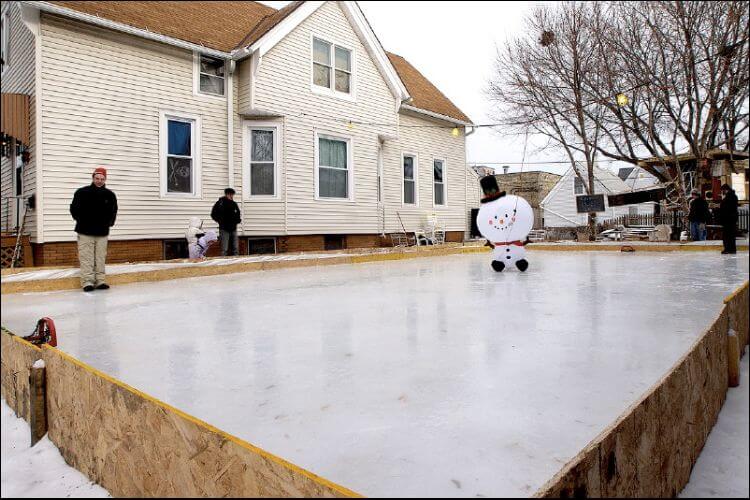
A backyard ice rink needs a suitable site, a frame designed to hold the water, a watertight liner and a sustained cold spell. Measure the ground before buying materials: water finds a level surface, so a sloping yard produces deeper water at one end and greater demands on the frame.
This guide covers a temporary, ground-supported backyard rink. Use the detailed construction and filling instructions for your chosen rink system. These steps are not instructions for judging the safety of a frozen pond or lake.
1. Decide how the rink will be used
Allow for the skaters, supervision, access and snow storage, not just the largest rectangle that fits. A smaller rink may be easier to fill and maintain. Hockey also needs consideration of where pucks could travel toward people, windows, vehicles or neighboring property. Plan appropriate containment rather than pointing play toward a house.
2. Check the site and drainage route
Choose a location with convenient, safe access for maintenance. Avoid obstructing doors, paths or necessary drainage. Decide where meltwater can go before adding thousands of gallons. Keep discharge away from foundations, neighboring property and places where runoff would refreeze into a hazard. Check local water-use and drainage requirements.
3. Measure the slope
Use a level reference to measure the height difference across the entire footprint, including corners and low spots. Do not judge slope by eye. NiceRink’s buying guide illustrates the consequence: six inches of ground fall with four inches of water at the high end means ten inches at the low end. Different rink systems have different limits.
If the resulting depth exceeds your system’s design, reduce or relocate the rink or obtain a suitable design. Adding taller boards without checking supports does not solve the loading problem.
4. Calculate the water requirement
For an approximate volume, multiply area in square feet by average depth in feet, then by 7.48 to get US gallons. A level 20-by-30-foot rink filled four inches deep holds about 1,496 gallons. A slope increases the average depth and the amount required.
Check supply capacity and cost, especially with a well, before filling. A calculation is a planning estimate, not permission to exceed the frame’s allowed depth.
5. Choose a complete frame design
Use a tested rink kit or a properly designed frame with supports appropriate to the water depth and soil. Boards and bracing have to contain liquid water during filling and thaws, not only solid ice. A generic list of narrow boards and rebar is not an adequate structural specification.
Follow the system’s required board dimensions, bracket spacing and anchoring. NiceRink’s installation instructions, for example, give limits specific to its brackets. Do not apply those limits to unrelated homemade supports. Check for underground utilities before driving stakes, and keep protruding hardware away from users.
6. Prepare the ground
Remove stones, sharp debris and other objects that could puncture the liner. Follow the manufacturer’s requirements for the underlying surface and timing of setup. Do not undertake major grading that changes drainage without considering its wider effects.
7. Assemble and inspect the enclosure
Install the frame and supports exactly as designed, then inspect joints, corners and anchors before filling. Confirm that the planned waterline is within the allowable depth everywhere. Provide safe entry and exit, and remove exposed sharp edges or projections from the skating area.
8. Fit the liner with sufficient slack
Use a liner intended to hold rink water, sized for the footprint, sides and depth at the lowest point. A general-purpose tarp may not be watertight. Fit the corners and base without stretching the material tight across voids; water pressure will push it down.
Secure it only as the system directs. Avoid punctures below the planned waterline and do not trim off useful excess before the final fit is established. Keep pets and sharp tools off the liner.
9. Wait for suitable weather
Look for sustained freezing conditions and follow the rink manufacturer’s filling guidance. A single cold night is not a reliable basis for opening the rink. Freeze time changes with water depth, weather, ground conditions and snow cover; a fixed promise such as six to eight hours is not dependable.
10. Fill using the system’s method
Monitor the frame, liner and waterline as filling begins. Stop if supports shift or a leak develops. Keep people away from the enclosure while problems are investigated.
Filling methods differ. YardRink’s instructions describe a staged freeze for its system and specify at least four inches of ice throughout. That does not establish the correct method or structural limits for every rink. Follow your own system’s instructions rather than combining pieces of different methods.
11. Check the ice before allowing skating
Verify the actual ice condition and the thickness required by your rink system throughout the surface, including edges and the deepest area. A hard crust can conceal unfrozen water. Tapping with a broomstick or seeing frost on top is not an adequate readiness check. Keep the rink closed while the required condition is uncertain.
Inspect again before use and after changes in weather. Provide supervision appropriate to the skaters and properly fitted protective equipment, including a suitable skating or hockey helmet. Keep non-skaters clear of moving skaters and hockey play.
12. Maintain it and manage thaws
Remove loose snow and shavings with tools that will not damage the liner or boards. Follow the system’s resurfacing instructions; do not assume a large layer of hot water is always appropriate. Repair surface defects before reopening.
During softening or a thaw, close the rink. YardRink’s thaw guidance advises leaving soft ice undisturbed rather than shoveling, chipping or adding water. Reassess after refreezing; a return to cold weather alone does not confirm a sound surface.
13. Drain and store it carefully
At season’s end, restrict access and follow the system’s drainage and dismantling directions. Release water gradually along the route planned at setup. Do not remove a loaded wall to dump the water all at once. Avoid adding charcoal, fertilizer or other substances as an improvised melting treatment.
Clean and dry reusable components, inspect damage and store them as directed. Record the measured slope, fill volume and maintenance issues to improve next season’s plan.
Main image source: 1.


