A bamboo trellis can support light climbing crops or flowers when its joints and anchorage suit the site. Three useful layouts are a flat lattice, a fan and a three-legged tripod. Choose the plant first: a lightweight seasonal frame is not a dependable support for a heavy woody vine.
Plan the size and gather materials
Sketch the finished width and height, allowing for the portion of each upright that will be secured in the ground or another suitable support. Leave access for harvesting and maintenance. Consider wind exposure and the plant’s mature weight, including wet foliage and fruit.
Gather sound bamboo canes, outdoor lashing cord, a tape measure, pencil and a suitable saw if cuts are needed. Inspect for splits and weak or decayed sections. Choose cane thickness for the project rather than assuming any bundle will carry a full harvest. Wear eye protection and gloves when cutting, secure the cane and smooth sharp cut ends.
Locate buried utilities and irrigation before pushing stakes into the ground. Keep projecting cane ends away from faces and paths, and use suitable cane caps where needed. The RHS guidance on plant supports emphasizes anchoring supports so the plant and frame do not blow over.
1. Make a flat lattice trellis
Lay the uprights on a flat surface at the spacing shown in your sketch. Place crosspieces across them, leaving enough overlap at the outer uprights to secure the joints. Adjust the grid to suit the plant: fine tendrils need something they can grasp, while other climbers may need loose plant ties.
Lash each intersection rather than depending on friction alone. Wrap the crossing firmly, tighten the wraps with turns between the poles where appropriate, and finish with a secure knot. Test each joint by hand; it should not slide freely along the cane. Follow a demonstrated lashing method if you have not used one before.
The original woven look can be achieved with suitable flexible material, but do not force thick, dry canes to bend alternately around uprights. They can split. A tied grid is easier to inspect and repair. The trellis is not finished until it is anchored upright and checked for movement.
2. Build a fan-shaped trellis
Arrange several uprights with their lower ends relatively close together and their tops spread into a fan. Add crosspieces at more than one height so the layout holds its shape. Mark intersections before tying so you can compare the assembled frame with the sketch.
Cut only after checking the measurements and required anchoring length. Where practical, leave a closed node near the top end rather than an open hollow that collects water. This does not make bamboo rot-proof; inspect it regularly, especially where it contacts damp soil.
Lash the intersections and check that the fan cannot simply fold sideways. Secure the lower ends and provide additional support as the design and site require. A narrow base with a broad top catches wind, so do not assume the fan is stable because its joints feel tight while lying on the ground.
A fan is useful for a small display against a suitable support, but any fixing to a wall or fence must be appropriate for that structure. Do not attach a growing load to a loose fence panel or an unknown wall surface.
3. Assemble a bamboo tripod
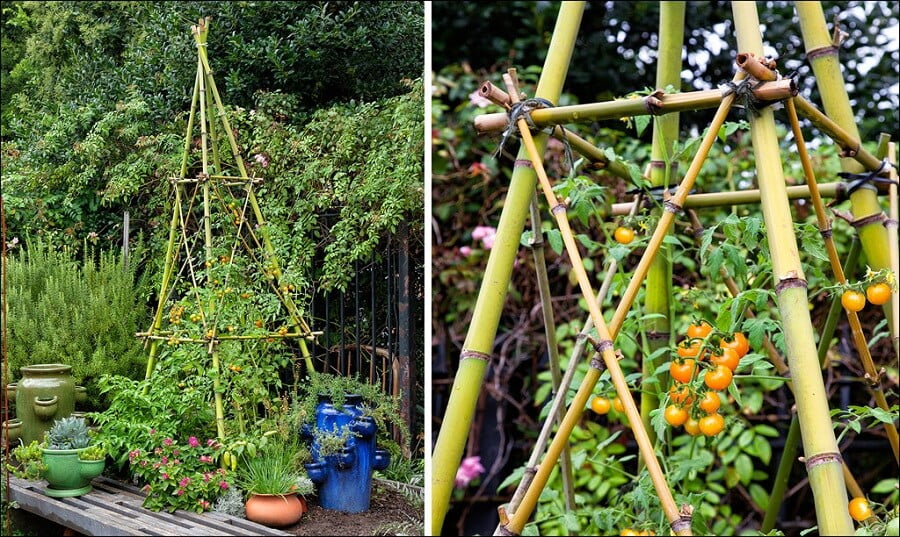
Choose three sound canes of compatible length and strength. Lash them together near the top while allowing enough movement to spread the legs. Open them into a broad, stable triangle, then secure each leg for the intended site. Recheck the top lashing after opening the frame.
Outdoor cord avoids exposed cut-wire ends, though it still needs inspection and replacement when worn. Add horizontal cord runs or additional canes if the plant needs more climbing points. Keep ties clear of constricting stems and allow space around the base for watering and harvesting.
Check stability before planting and again as growth adds weight. If the legs sink, spread or wobble, improve the design before allowing a plant to cover it. A tripod for plants is not climbing or play equipment.
Choose plants and maintain the frame
Light seasonal climbers are a more realistic starting point than vigorous woody honeysuckle or trumpet vine. Select a species suitable for your region and the frame’s capacity, checking local invasive-plant advice before buying. The RHS ideas for vegetable supports show how plant choice and support design work together.
Inspect knots, canes and anchorage after strong wind and during routine watering. Replace damaged components before they fail. At season’s end, remove spent growth carefully, dry reusable canes and store them under cover. Discard weakened pieces rather than hiding them inside next year’s frame.
If buying a ready-made trellis, compare its intended plants, dimensions, anchoring instructions and replacement options. An expanding panel still needs secure installation. Confirm current specifications and price with the seller; an old product list does not establish that a model is available or suitable.
Featured image source: original credit.