Originally contributed by Robert from Sawinery.net; revised with safety guidance.
A chainsaw can cut suitable wood quickly, but it is not the right tool for every backyard task. Choose a saw and job within your training, follow the model’s manual and recognize situations that need an arborist. The five uses below describe where a chainsaw may fit—and where another tool is a better choice.
1. Cutting suitable logs into firewood lengths
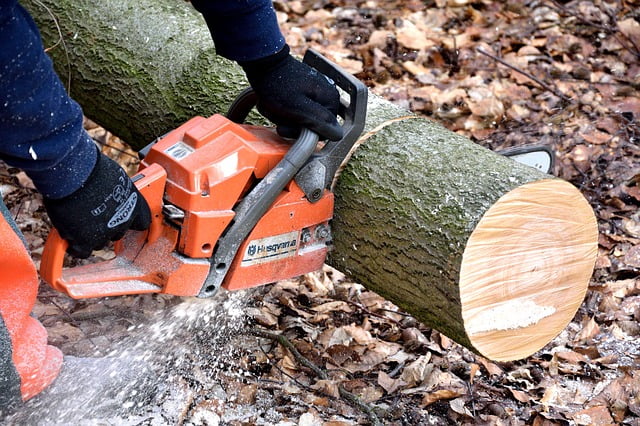
Crosscutting a log into shorter sections is called bucking. It is one of the most familiar chainsaw jobs, but the log must be stable and its potential movement understood. Timber can roll, settle or pinch the cutting equipment; a fallen tree is not automatically safe to cut.
Use training appropriate to the job rather than improvising a sequence of cuts. Keep the cutting equipment out of soil and away from concealed metal. A chainsaw cuts wood into lengths; it does not replace a splitting tool for making those lengths into smaller firewood pieces.
2. Processing detached branches on the ground
Some clean, stable branches are suitable for chainsaw work after they have been safely removed. Small flexible material is often easier to control with loppers or a pruning saw. Do not hold a branch with one hand while operating a chainsaw with the other.
Storm-damaged branches may be bent or trapped under load. Leave spring poles, hung-up limbs, unstable trunks and material near power lines to qualified professionals. The fact that debris is lying in your own yard does not remove these hazards.
3. Limited pruning where the tool and access are appropriate
Most routine shrub and small-tree pruning is better done with hand pruners, loppers or a pruning saw. A chainsaw is not a general-purpose substitute for those tools, and a large cut is not necessarily good for tree health.
Do not operate a conventional chainsaw from a ladder or above shoulder height. Work requiring climbing, overhead cutting or removal of heavy limbs belongs with a trained arborist. A pole saw is a different tool with its own limits and instructions, not permission to stand under falling wood.
4. Preparing clean timber for a project
A suitably trained user may rough-cut clean timber where the saw is designed for that work. Inspect reclaimed material for nails, screws, wire, rot and contamination first. Timber used for furniture or a structure may need more precise tools and design work after rough sizing.
Do not assume that a wood-cutting chainsaw can cut masonry, tiles, metal or any material just by changing the chain. Specialized concrete and masonry saws are separate systems with specific cutting equipment, operating instructions and dust controls.
5. Learning chainsaw carving as a specialist craft
Carving is a skilled use of the tool, not a casual beginner’s activity. Learn with a qualified instructor, suitable equipment and a controlled workspace before attempting it. Watching a carving demonstration does not establish that a standard saw, chain and setup are appropriate for the same work.
If you simply want a carved feature in the garden, commissioning an experienced maker avoids buying equipment for a task you may use only once. Position finished work on a stable base and maintain the wood as its maker recommends.
Jobs to leave off the list
Do not use a chainsaw to texture icy paths, cut openings in a frozen garden pond or work while standing on ice. Those suggestions combine unstable footing with a hazardous cutting tool. Use appropriate ice-management methods and obtain pond-care advice suited to the site instead.
Do not improvise attachments or disable a chain brake, guard or other safety feature. If the saw is damaged or a safety mechanism fails, stop using it and arrange service.
Prepare before every use
The CDC’s chainsaw-safety guidance emphasizes protective equipment, secure footing and keeping others clear. Use the protection specified for the saw and task, including eye, hearing, leg and foot protection. Inspect the equipment and follow the manual for starting, carrying, stopping and maintenance.
Keep children, pets and bystanders outside the work area. Stop if conditions become slippery, visibility deteriorates or fatigue affects control. An expensive saw does not make an unsuitable job safe, and choosing a smaller hand tool or hiring help is often the soundest backyard decision.