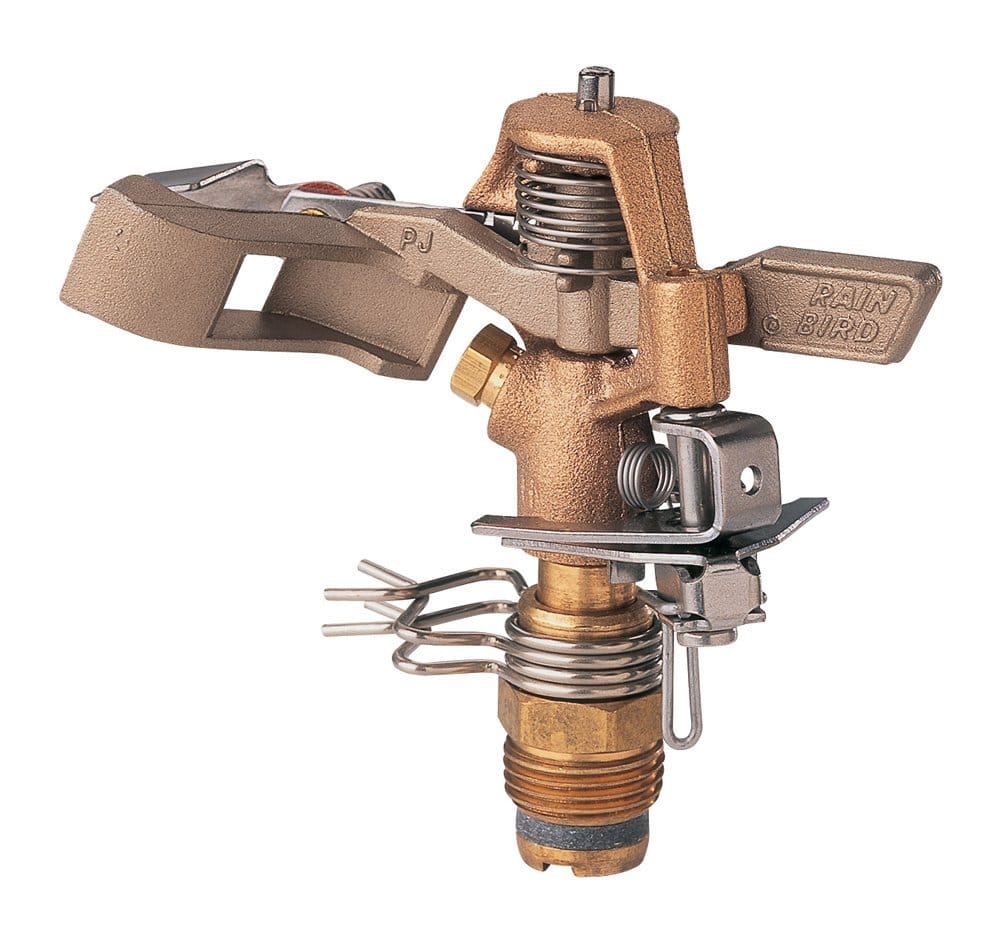
The Rain Bird 25PJDA-C is a brass impact sprinkler head with adjustable full- or part-circle coverage. It is a head for an appropriate mounting and water supply, so confirm what the purchase includes before assuming it is ready to attach directly to a garden hose. This guide uses manufacturer specifications and explains the practical checks; it is not a new durability test.
Identify the head and its connection
Rain Bird’s 25PJDA-C product page lists brass, bronze and stainless-steel construction, full-circle operation or a 20–340-degree part circle, and a deflector-adjusted radius of 20–41 feet. The connection is 1/2-inch male pipe thread. Radius measures outward from the sprinkler, not across the entire circle.
Do not confuse that head with the 25PJ hose-end spike assembly, which Rain Bird lists with an included stake and a 3/4-inch female hose-thread connection. The mounting and inlet are part of the buying decision. Pipe threads and garden-hose threads are not interchangeable just because a fitting appears similar in size.
Match the pattern to the area
Full-circle operation suits an open area around the head. Part-circle operation can help at an edge where water should remain on one side. A large radius does not mean one head will irrigate every corner of an irregular garden or provide uniform coverage around obstacles.
Measure the planting and mark the proposed mounting position. Consider whether shrubs or other objects will block the stream and whether the outer part of the pattern would reach a wall, path or neighboring property. Moving the position may be more useful than trying to force a setting that does not fit.
Understand the adjustments
The manufacturer describes a deflector flap for distance and a diffuser screw for breaking the stream into smaller droplets. These controls alter the pattern; they do not remove the need to observe the water landing. Use the matching manual for arc adjustment and mounting, and keep hands clear of the operating impact arm.
Change one setting, watch the resulting rotation, then reassess. Reducing reach can also change distribution. A partial arc concentrates watering into a smaller sector, so do not assume the runtime used for a full circle remains appropriate.
Check water supply rather than judging by head weight
A metal head does not need pressure simply because it is heavy. Operation depends on the design’s specified flow and pressure requirements and the supply available at the sprinkler. A long hose, narrow fittings or simultaneous demand elsewhere can affect performance.
Use Rain Bird’s matching performance chart and installation guidance when assessing a proposed setup. If several sprinklers are connected, their combined demand matters. A base with a second outlet is not proof that the supply can run every head effectively at once.
If the sprinkler fails to turn or reverse, stop and check the setup and manufacturer troubleshooting guidance. Do not increase pressure beyond equipment limits, bend the mechanism to force operation or treat lubrication as a universal cure.
Durability and ease of use
The materials are a concrete product feature; a promise of lifetime operation is not. Inspect the head, springs, connection and mounting for damage, and follow its cleaning and storage directions. An unattributed story about a decades-old sprinkler cannot predict the life of a new one.
People with limited hand strength should examine the actual adjustment controls before buying. “Easy to adjust” is subjective, and the old reassurance that it would be easy for anyone with arthritis was not justified. A seller demonstration or a suitable return policy is more useful.
Before purchase
Confirm the full model number, inlet type, included mounting hardware, supply requirements and current warranty terms. Compare the total cost of the head plus the needed support and fittings. The 25PJDA-C is a possible choice for an appropriately supplied circular sector, but it is not automatically the best option for every lawn.
See our guide to lawn sprinkler types for other patterns and mounting approaches.