


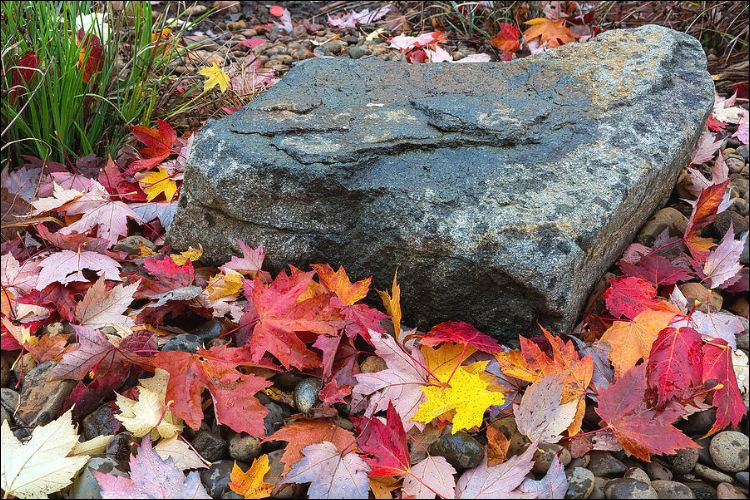
Large stones or boulders can turn a dull landscape into a very interesting one. However, this doesn’t mean you can just place a rock anywhere in your backyard and you’ll have a nice design. Things are a little bit more complicated than that. For this reason, today we will show you what you should know about landscaping with boulders and offer you a couple of suggestions.
What You Should Know about Landscaping with Boulders
1. What Boulders to Use?
Naturally, not any rock you’ll stumble upon is going to fit your space perfectly. However, it would be best to use a rock either from your property or from a place that is close to your home. Otherwise, if you choose to carry it (or them) from a long distance, it can become quite expensive. Look at the type and the color of the rocks that appear naturally in your area. Choose a boulder that resembles them to make it look more natural.
Another thing to pay attention to is the size. The boulder should always be proportional to the location. For example, if you have a small yard, you shouldn’t go for a very large stone. At the same time, if you have a giant property, don’t place small rocks in the center. Lay the rocks in groups if you want them to look natural.
2. Boulder Shapes
Obviously, there are plenty of boulder shapes, which makes a choice even harder. How can you know which one to use? Here you have a quick rundown of the most common boulder shapes:
- Tall vertical – this shape is taller than wider. Usually, it’s placed on the taller half (for a waterfall, for instance), or set as the central stone in a complex composition. You can think of it as the hinge of a composition on which the other stones rely.
- Low vertical – this is wider rather than tall. It resembles the first shape but considering its height, it’s much wider. The massive stone often accompanies tall vertical boulders, so don’t place it like a monolith.
- Arching – The third option is a rather odd shape that overhangs either on the right or on the left. People also call it a thrusting stone. It gets slightly lower than the low vertical type of boulder and it brings stability and strength to the essential points of your garden. Place it at an angle if you want to have a prominent arch.
- Flat – Perhaps the simplest option, a flat boulder measures less than a foot tall, but it has no limits on width and length. It has a flat top surface and most of the time, people use it in front of a composition, as a bridge, next to a body of water, or as walks and stepping stones.
- Reclining – The last boulder shape looks like a reclining animal. Its head is on one end, being narrower and higher than the hips found at the other end. It brings plenty of strength to your space, which is why people call it an ox stone. The diagonal top line can be used to draw the eye to other element(s) found nearby in the garden, just like a pointer.
3. Are You Allowed to Use Them?
Before starting to think about landscaping ideas, it would be useful to check if you have the permission to use them. Check with the local government, as well as any homeowners’ association if you belong to one. See if there are any rules or other laws that restrict the use of boulders. Obviously, if you have a landlord, you should ask for their permission first. Lastly, make sure you place it on your property, not on a shared access route or an easement.

4. Choose the Location
You need to have a clear route if you want to move the boulder into the location. Moreover, the equipment you are going to use needs enough space as well. Before excavation in the U.S., contact 811 and follow your state’s notice and response requirements. Arrange identification of private lines and septic systems separately where needed. You shouldn’t place boulders over any such places. Furthermore, you shouldn’t restrict any access for the emergency personnel or public utility lines. Finally, think about what other plans you have in the future for the property and see if it’s a good idea to place a boulder where you intended to.
5. Prepare the Site
After you made sure the location is okay, it’s time to prepare the site. Make sure there is no sod or other vegetation in the area you marked for the boulder. A shallow depression may change appearance, but a fixed two-inch depth does not establish stability. Have an experienced installer assess the stone, ground, drainage and loads before specifying its embedment and base.
6. Set the Boulder in Place
The next step for landscaping with boulders is to set the rocks in place. If the boulder is very big, make sure you have the right equipment to move it safely. Use an experienced contractor with suitable rated equipment for heavy stones. Do not improvise a truck-winch or hand-rolling method. Keep people clear of the movement path and suspended loads; equipment access and ground capacity belong in the installation plan.
7. Use a Base
In some cases, it’s essential for the boulder to stay right where it is. For example, if you integrate it with paving or you make them a focal point in your design. There is no universal concrete-and-gravel base that guarantees against movement. The installer must choose a foundation and setting method suitable for the stone and site. It’s a good idea if you want to obtain a dramatic setting as well. A boulder on a slope needs professional assessment of stability and the consequences of movement, not a generic instruction to anchor it. This is a useful tip to remember if you’re landscaping with pavers as well.
Ideas on Landscaping with Boulders to Inspire You
1. Lighting Boulders
If you want to create an original setting in your backyard, it’s a good idea to light the boulders. The most important rule here is to light at night only the ones that are focal points during the day. As such, you can use a spotlight that will convey a warm glow. At the same time, you can also go for backlighting. If you have any trees behind a group of boulders, you can up light it and create an effect like a silhouette.

2. Mimicking Nature
This is a great idea for those who want to achieve a look as natural as possible when landscaping with boulders. For example, if you place all the boulders with the flat side up, you will only have a methodical, mundane aspect. If you look in nature, you will notice that the boulders there aren’t placed symmetrically or in a certain order. Get creative when landscaping with boulders and place them in a variety of ways. Let some of them stay flat, while others should stand upright.
3. Grouping Boulders
A single stone can be a deliberate focal point, while a group creates a different composition. Three stones are enough to form a natural-looking group, so don’t be afraid to mix them up. A good technique is to place two of them close to each other (even touching), and set the third one nearby.
4. Edging
If you want to obtain a natural edging to a flowerbed, it’s a good idea to use boulders. Decorative edging is different from a retaining wall. Holding back soil introduces structural and drainage requirements; obtain an appropriate design and check local approvals before treating boulders as a wall.
5. Lining the Front Yard
Boulders can visually define a frontage, but spacing and placement must preserve safe access, sightlines, drainage and required setbacks. Do not treat decorative rocks as a crash-rated barrier or assume they will protect a house from vehicles. Roadside protection and parking stops require an appropriate design and local approval.
6. Concealing Unattractive Features
Your lawn may not be perfect, and it’s okay for it to be like this. However, if there are some parts you want to hide, such as a utility box that is exposed, you can use a large boulder to mask it. However, make sure there is enough room for the utility workers to access the box if that is the case.
7. Growing Moss
Moss can soften the appearance of suitable stone in a moist, sheltered setting, but it is optional. Iowa State Extension advises against moss-and-buttermilk blends; choose a suitable species and conditions instead. Do not collect moss from land without permission or encourage slippery growth on walking surfaces.
Conclusion
Landscaping with boulders is a great idea both aesthetically and practically. Adding large stones to your front yard can make it more attractive, and you can play around with various styles. At the same time, you can use the rocks smartly to conceal certain features in your space. Regardless of the reasons you have for using them, make sure you are manipulating them in a safe manner.
Images source: depositphotos.com


