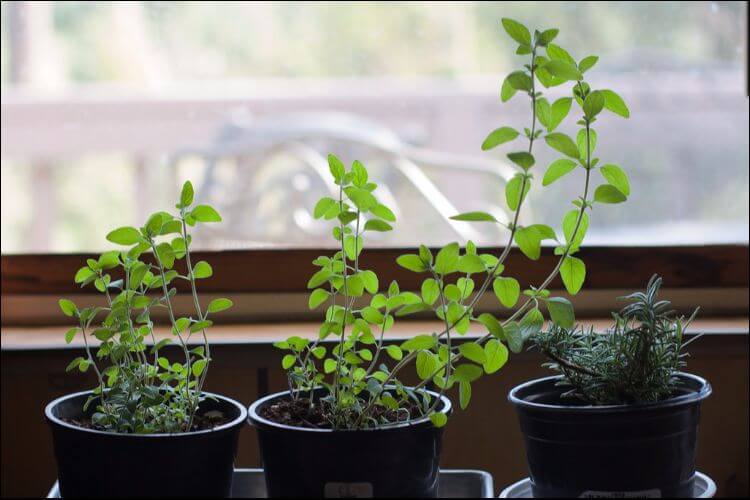
Start an indoor herb garden with a few herbs you use in cooking, a bright growing area, pots with drainage and a suitable potting mix. Smaller, regular harvests are a more realistic goal than expecting a few windowsill plants to supply every meal.

Choose herbs and starting plants
Chives, parsley, mint, basil and other culinary herbs can be grown indoors when their conditions are met. Check the needs of each species: basil wants warmth and strong light, while woody herbs such as rosemary can be challenging in a dim room.

Buying a healthy young plant may give a usable harvest sooner than sowing seed. Inspect stems and both sides of leaves before bringing plants home. Keep new arrivals apart while checking for pests. If sowing, follow the seed packet rather than assuming every herb germinates or matures in the same number of weeks.

Provide light that supports growth
Use the brightest suitable location and rotate pots if growth leans toward the window. Supplemental grow lights can help when sunlight is inadequate. Follow the fixture’s height and coverage instructions, and provide a daily dark period.

There is no universal 18-hour minimum for all herbs. For winter challenges, including cold windows and slow growth, see keeping an indoor herb garden through winter.

Use containers that drain
Choose pots with drainage holes and enough root space. Place a saucer underneath to protect furniture, then empty it after excess water drains. Separate pots make it easier to water herbs with different needs; compatible herbs can share a sufficiently large container.

Use a potting medium suited to the plants. Do not add gravel, tile fragments or stones as a drainage layer. Avoid an arbitrary hydrated-lime recipe: potting-mix pH adjustments require appropriate testing and product guidance.
Water and feed according to growth
Check the medium and pot weight before watering. Apply water evenly so the root ball moistens and excess can drain. A fixed two- or three-times-weekly schedule can be too much in one room and too little in another.
Check whether the mix already contains fertilizer. Feed actively growing herbs with a product suitable for edible container plants, following its directions. Routine vitamin B1 or seaweed “boosts” are not required steps. If salts build up, address the fertilizer and water source as well as managing drainage.
Harvest without stripping the plant
Use clean scissors or fingers to take small amounts of healthy growth. Leave enough foliage for the herb to keep growing. For branching herbs such as basil, pinch above a leaf pair; for chives, harvest selected leaves appropriately rather than treating every herb like a woody shrub.
Inspect regularly for pests and remove dead material. Maintain spacing and air movement. When an annual herb becomes exhausted, sow or buy a replacement instead of expecting it to produce indefinitely.
For further care guidance, see Penn State’s indoor herb guide and Maryland’s container-herb guide.
Image source: 1