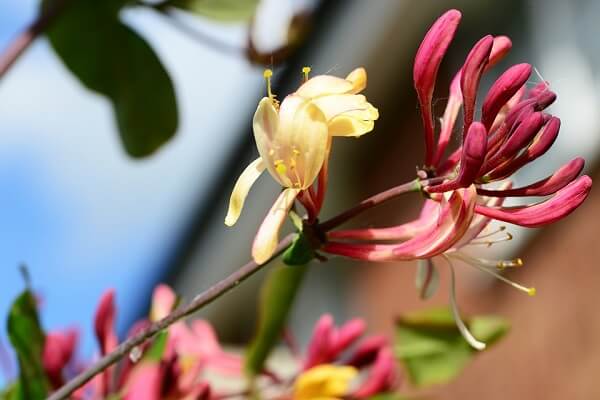
Honeysuckles belong to the genus Lonicera and include both climbing vines and freestanding shrubs. Care depends on the species: some are deciduous, some retain foliage in suitable climates, and fragrance, flower color and flowering time vary. Identify the plant before choosing a site, support or pruning method.
Also check its local status. A honeysuckle sold or admired in one region can be invasive in another. “Honeysuckle” alone is not enough information to make a planting decision.
Choose a Suitable Honeysuckle
Decide what you want the plant to do. A climber can cover an appropriate trellis or fence; a shrub needs room for its own branches and does not automatically need climbing support. Check mature dimensions rather than expecting pruning to keep any species in a small space.
The RHS honeysuckle guide distinguishes the groups. For example, a winter-flowering shrub is a different garden choice from a summer-flowering vine. Local native-plant or extension guidance can help select a species that fits your climate without creating an invasive-plant problem.

Site and Planting
Compare light, soil moisture and drainage with the requirements of the named plant. Avoid assuming that every honeysuckle wants the same degree of shade or tolerates drought equally well. In a dry position beside a wall, check how much rain actually reaches the soil.
Set the plant at the appropriate original root-ball level rather than burying it in a fixed 18-inch-deep hole. Give roots adequate planting width, water in thoroughly and keep mulch clear of the stem base. A deep hole filled with rich compost does not compensate for unsuitable drainage.
For a climber, install a strong support suitable for its eventual size. Guide young stems with soft ties where needed, leaving room for thickening and checking ties regularly. Do not tightly bind stems with a narrow cord that can cut into them.
RHS guidance for climbing honeysuckles covers establishment and training. New plants need monitoring through dry weather even when established specimens of the same species are relatively resilient.
Watering and Feeding
Check moisture around the roots before watering. The right interval changes with weather, soil, plant size and whether the plant is in the ground or a container. Waterlogged soil and drought can both cause poor growth; neither is solved automatically by fertilizer.
Use a soil test or local recommendation if nutrients are in question. A twice-yearly application of a particular fertilizer grade is not a universal requirement, and fertilizer does not reliably change soil pH to whatever a plant needs.
Pruning: Match the Flowering Habit
Identify whether the plant flowers on earlier growth or the current season’s growth before cutting. Some early-flowering climbers are pruned after flowering; later-flowering forms need a different approach. A winter-flowering shrub should not be treated as a summer vine.
Remove dead or damaged growth and manage stems that obstruct access. Keep routine trimming selective. Cutting every honeysuckle to a foot above the ground each winter can remove the next flower display and is not ordinary care for the whole genus.
For a severely overgrown plant, first confirm its identity and whether it is worth retaining. Seek species-specific renovation advice. If it is invasive locally, controlling or replacing it may be more appropriate than encouraging fresh growth.
Invasive Honeysuckles
Penn State Extension’s Japanese honeysuckle guidance describes concerns with Lonicera japonica. Several introduced shrub honeysuckles are also invasive in parts of North America. A name, a single stem feature or a pleasant scent is not sufficient for reliable identification.
Confirm the species with local guidance and plan removal according to plant size and site. Small plants may be removable by hand when conditions allow; established plants can resprout and require follow-up. Avoid moving fruiting material into natural areas.
Do not improvise an undiluted herbicide treatment or use one fixed concentration for every product. If chemical control is appropriate, follow a locally applicable extension recommendation and the exact product label for the plant, site and method. Protect nearby desirable plants and waterways.
Pests, Poor Flowering and Moving a Plant
Aphids or damaged leaves do not automatically mean the whole plant must be destroyed. Inspect the affected growth, record symptoms and check plant stress before deciding on treatment. For poor flowering, consider the plant’s normal season, light levels and whether pruning removed flower-bearing growth.
If moving a honeysuckle, prepare the new site first and choose a suitable cool or dormant period for the species and climate. Preserve a workable root ball, keep roots from drying out and provide aftercare. Last-minute root pruning and removing a fixed fraction of the canopy are not universal transplanting steps.

Flowers and Berries Are Not Automatically Food
Do not add unidentified honeysuckle flowers or berries to salads or drinks. Edibility cannot be generalized across the genus, and ornamental plants may also have been treated with products unsuitable for food crops. RHS lists the fruit of Lonicera sempervirens as ornamental, not edible.
Enjoy a suitable honeysuckle for its garden role and seasonal display. Species identification, sensible placement and pruning at the right time are more useful than treating all honeysuckles as one plant.