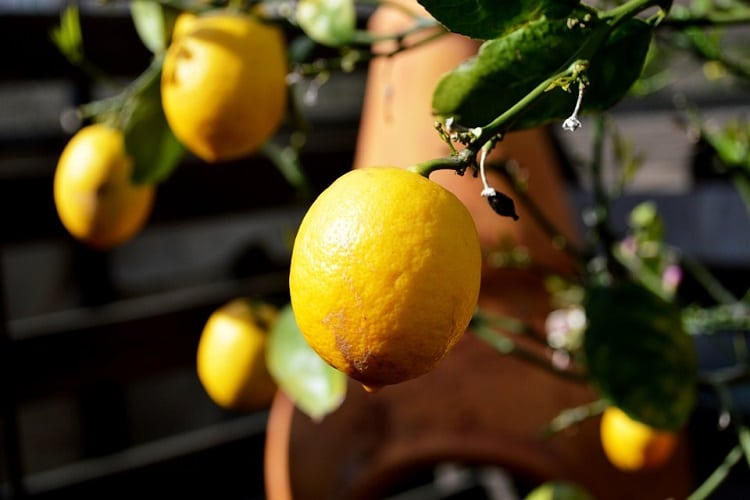
An indoor lemon tree needs strong light, a draining container and watering adjusted to its actual conditions. Keeping one alive as a houseplant is easier than obtaining a dependable crop. Start with a healthy named nursery plant of manageable size and treat fruit as an outcome to work toward, not a guaranteed reward on a fixed schedule.
Meyer lemon is a common choice, but the variety name does not prove a tree is grafted onto dwarfing rootstock. Ask the supplier about propagation, expected size and suitability for container growing. A seedling may be enjoyable, but its size and time to fruit are much less predictable.

Put light first
Choose the brightest suitable window available and observe how much direct light reaches the foliage through the season. A bright-looking room may provide much less usable light than an outdoor location. If window light is insufficient, use a plant light positioned and operated according to its specifications.
Do not choose a grow light by an arbitrary wattage alone. Coverage, distance and output matter, and the entire canopy needs appropriate exposure. Rotate the pot if needed for balanced growth without making abrupt changes that scorch previously shaded leaves.

The University of Maryland’s dwarf-citrus guidance describes strong direct light and gradual transitions outdoors. Its advice reinforces why a dim corner is unlikely to support fruiting even if the tree survives there.
Use a pot that drains and a mix suited to containers
Choose a container with drainage holes and a freely draining potting medium. Do not use a decorative outer pot as a reservoir for standing water. Check it after watering and empty accumulated water.

Repot when the roots and watering behavior justify it, rather than following a universal percentage increase. Avoid burying the trunk or graft union. A very large wet volume around a small root system can be harder to manage than an appropriately sized container.
Water according to the root zone
Check the potting mix before watering. When water is needed, wet the root zone thoroughly and let excess drain. The interval changes with light, temperature, pot size and growth. Indoor winter conditions often reduce water use, but that is a reason to check more thoughtfully, not to impose a fixed dry period.

Do not use daily leaf misting as a substitute for root-zone watering. Keep the tree away from hot drying vents and abrupt cold drafts. Ordinary suitable indoor conditions are preferable to trying to hold every lemon tree at 85°F; the University of Minnesota describes citrus growing in much cooler indoor temperatures.
Feed without combining incompatible schedules
Select a citrus-appropriate fertilizer and follow the product directions for a container plant and its growth stage. Avoid automatically combining slow-release granules with frequent liquid feeds. A tree growing slowly in weak winter light should not be pushed with extra fertilizer to compensate for insufficient light.
Yellowing can have several causes, including root problems. Review watering, drainage, light and pests before diagnosing a nutrient deficiency. Record what you apply so another household member does not unknowingly double the dose.
Help flowers without promising fruit
Indoor flowers may benefit from gentle hand pollination because insects are absent. This can help pollen transfer, but it does not overcome poor light, stress or an immature tree. It is not honest to promise fruit simply because every flower was brushed.
Allow the tree to shed some flowers or young fruit without immediately changing every part of its care. Track its condition and growth. Seed-grown plants may take a long time to flower and can outgrow the available space; a known nursery plant offers a clearer starting point.
Inspect pests and manage seasonal moves
Check leaf undersides and stems for pests such as scale or mites. Isolate a new or affected plant where practical and identify the problem before treatment. Any pesticide must be labeled for the pest, indoor setting and edible citrus crop; a general houseplant product is not automatically appropriate for fruit you intend to eat.
If the tree spends summer outside, wait for suitable conditions and acclimate it gradually to stronger light. Inspect and prepare it before moving back indoors. For the broader planting and harvest sequence, see how to grow a lemon tree; indoor care adds the light and container constraints described here.