A Gilmour adjustable circular sprinkler can suit an open lawn where you want to set a full circle or a limited watering sector. The model number matters: Gilmour sells several circular heads and bases, and their materials, controls and coverage are not identical. This guide explains the older heavy-duty sled-base design and the checks needed to compare it with a current listing.
Match the model, not just the name
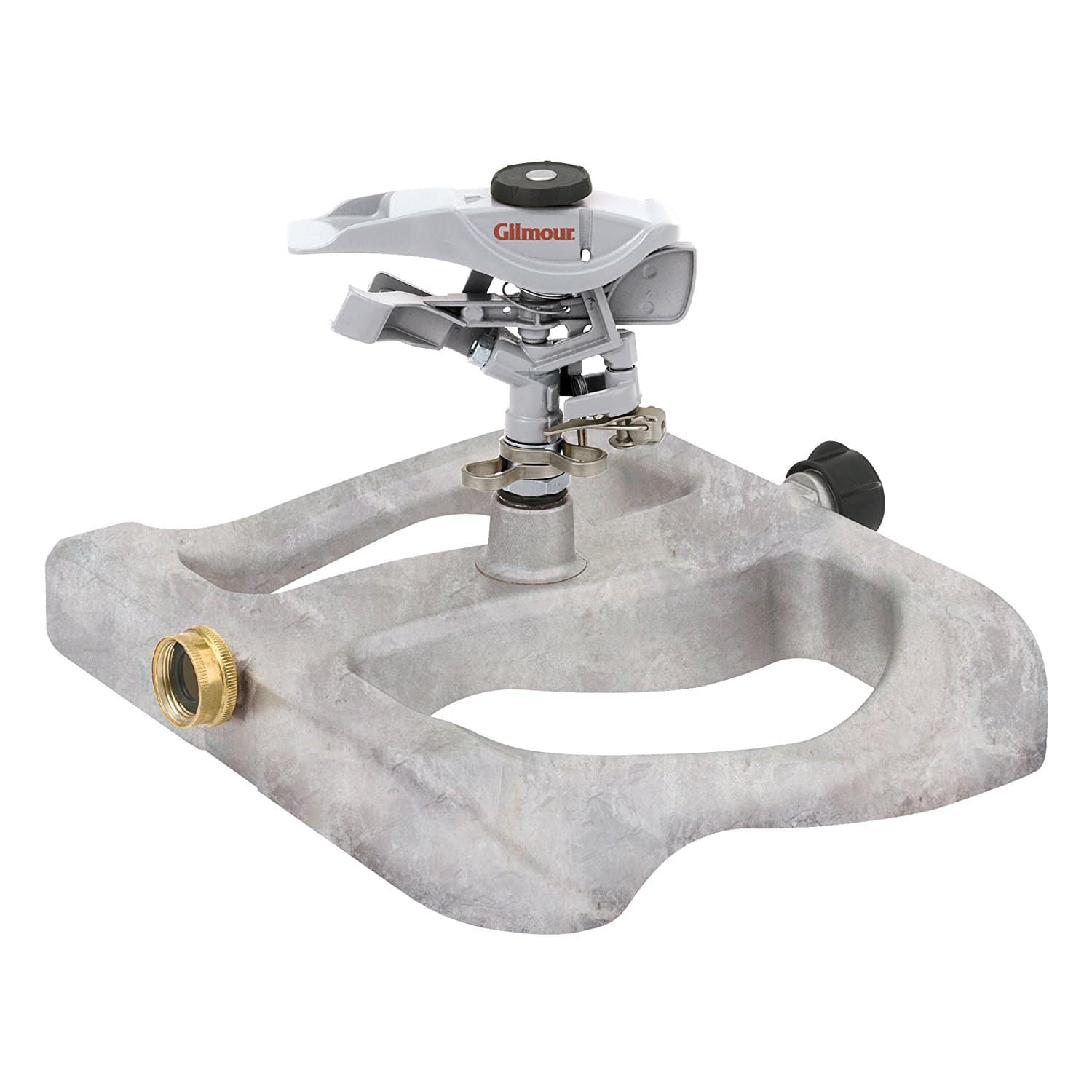
Gilmour’s model 1673 page lists up to 5,800 square feet, an 86-foot diameter and a 43-foot spray distance, with metal and polymer materials. Its base model with an on/off switch also lists up to 5,800 square feet but has a different control arrangement. Neither listing establishes that every older “Heavy Duty Adjustable Circular” unit has the same base or features.
The 86-foot figure measures across a circle; 43 feet measures from its center to its edge. These published maximums are not a guarantee for every hose and water supply. Confirm the article number and its documentation before relying on a coverage figure.
Three adjustments with different jobs
The arc setting determines which portion of a circle receives water. Distance control changes how far the stream travels. A diffuser alters the stream into smaller droplets. If your version has all three, change them one at a time so you can judge the effect.
Use the unit’s marked stops and matching instructions for full- or part-circle operation. A moving arm or lever should not be forced while operating. If reducing distance creates a wet center and a dry edge, reassess the position and pattern instead of assuming the whole sector is receiving equal water.
What a sled base changes
A sled sits on the surface rather than relying on a spike driven into soil. This can make repositioning convenient and avoids repeatedly inserting a stake. It still needs stable ground and a hose arranged without a sideways pull.
A heavy base does not make the unit impossible to tip, and a metal head does not establish the life of every seal or adjustment component. Inspect the connection, base and moving parts, particularly when buying a used sprinkler. Follow the product’s handling warnings and maintenance directions.
Connecting additional sprinklers
Some versions provide an outlet for another hose. Verify that yours does before planning a series. The presence of that outlet does not establish how many sprinklers the supply can run or that the last one will match the first.
Test a single sprinkler, then observe what changes when another is added. Reduced reach or unreliable rotation is a reason to revise the layout or run separate areas, not to exceed pressure limits. Keep unused outlets properly capped with the parts intended for that model.
Choose a location that fits the circle
A large open area is easier to match than a narrow strip beside a house. Part-circle adjustment can keep the sweep away from one side, but fences, trees and corners still affect where the water lands. A sprinkler does not deliver a uniform rectangle merely because its arc is reduced.
Observe a complete cycle and check the boundary. Stop if water is running off before the soil absorbs it, and adjust watering to the planting and conditions. Do not use the maximum coverage number as a runtime instruction.
Buying and ownership questions
Compare the exact model’s controls, fittings, replacement options and warranty terms. Gilmour lists a lifetime warranty on the referenced models, but the actual terms and applicability to your purchase still need checking. Do not infer coverage for a different model or secondhand unit.
Old customer quotes and price comparisons are not a reliable durability test. The strongest reason to choose this design is a pattern and base that suit the yard, with controls you can operate comfortably. For other designs, see our lawn sprinkler guide.