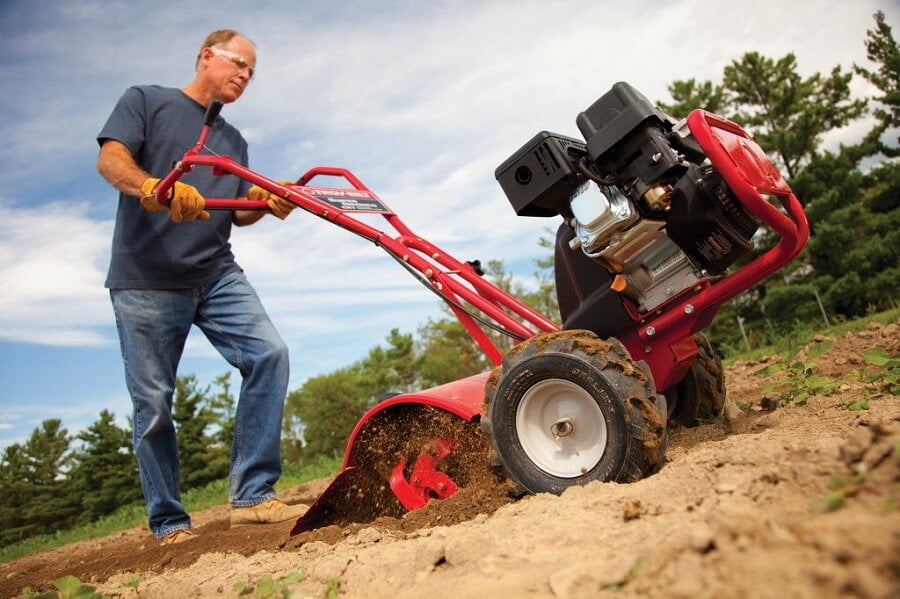
Choose a garden tiller for the job, soil and space you actually have. A small cultivator can maintain loose beds, while a larger tiller may suit preparing a new plot. Neither is essential for every garden, and buying more power does not solve every soil problem.
Before comparing models, decide how often you will use the machine, how you will move and store it, and whether renting would cover the work. This guide explains the main types and the checks that matter more than an old price list.
1. Decide whether tilling is needed
Established beds may need only surface maintenance and appropriate amendments. Repeated deep tilling can disrupt soil structure and bring buried weed seeds toward the surface. Minnesota Extension explains ways to reduce tillage.
Inspect a new site for buried services, rocks, roots and debris before planning machinery work. Use the local utility-location service where needed. Do not till wet soil simply because the calendar says it is time to plant; postpone work when the soil smears or compacts instead of crumbling.
2. Compare cultivators, front-tine and rear-tine machines
- Cultivator or mini cultivator: generally suited to mixing and maintaining previously loosened soil in smaller spaces. It is not automatically capable of opening hard, undisturbed ground.
- Front-tine tiller: often relatively compact and maneuverable. Consider its controls and the effort needed to manage it in your soil, not just engine size.
- Rear-tine tiller: commonly considered for larger preparation jobs. Check whether the wheels are powered and whether the tines rotate forward, counter to wheel direction or in selectable directions.
- Vertical-tine design: a different mechanical arrangement, not proof of superior results in every soil. Verify current availability, parts and the exact model’s intended tasks before buying.
Troy-Bilt’s comparison explains the broad distinction between cultivators and tillers. The manufacturer’s manual for the actual model should determine permissible use.
3. Match working width and depth to the garden
Measure gates, paths, beds and turning space. A wide machine may cover open ground quickly but be awkward near planted rows. Adjustable working width can be useful, provided it is a supported configuration.
Check how depth is controlled and whether the stated maximum is realistic for the job. Do not choose solely from a rule assigning horsepower to square footage: soil condition, machine weight, tine design, traction and operator control all affect suitability.
Hard or rocky ground does not simply call for the biggest engine. Some obstructions must be removed, and some sites need a different preparation method or professional help. Repeatedly striking rocks is not normal productive operation.
4. Consider power, handling and maintenance
A corded electric model needs a suitable power supply and cable arrangement. A battery model needs sufficient runtime and a compatible battery and charger. A gasoline model needs fuel, engine maintenance and safe storage. Compare the complete package rather than the bare tool price.
Check starting method, handle adjustment, transport wheels, balance and the controls you must hold during operation. Reverse can help maneuvering, but it is not a reason to ignore the manual’s precautions. Attachments and power take-off capability are model-specific.
For a gasoline engine, follow the exact fuel specification. Two-stroke and four-stroke requirements differ, and a blanket instruction to drain and run every engine dry is not appropriate. Use the manufacturer’s seasonal-storage procedure.
5. Compare renting with owning

Renting can suit a one-off new garden or an occasional large job. Ask for the total charge, including delivery or transport, deposit, fuel, cleaning and any damage terms. Confirm that the available machine is suitable for your site and that you receive operating instruction.
Buying can make sense for recurring work if storage and maintenance are practical. Include servicing, replacement tines, consumables, batteries where applicable and transport equipment. Request current local quotes: old hourly rental rates and broad price bands are not reliable shopping guidance.
6. Inspect a used machine carefully
Identify the model and obtain its manual before purchase. Check parts availability and inspect guards, controls, tines, cables, wheels and signs of leakage or damage. Have an experienced technician assess a machine if you cannot judge its mechanical condition.
Do not accept missing guards, defeated controls or unclear modifications as a bargain. Arrange any demonstration on a suitable site with the owner operating it safely. A low purchase price can disappear into repairs and unavailable parts.
7. Make a short comparison sheet
- Task and soil the manufacturer says the machine can handle.
- Working width, depth adjustment and overall dimensions.
- Weight, transport method and storage footprint.
- Power source, included accessories and ongoing maintenance.
- Local service, spare parts, warranty and total current cost.
- Rental cost for the same job, including transport.
Choose the smallest practical option that can safely do the required work, rather than the most powerful model you can afford. If the garden can be maintained with hand tools and less disturbance, that is a valid outcome of the comparison.