


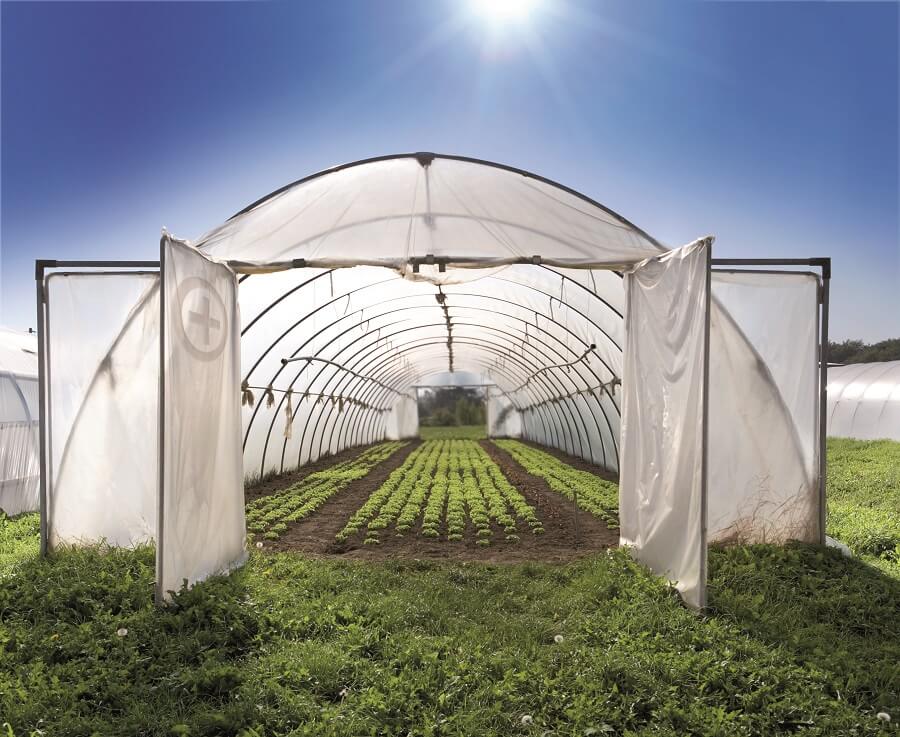
Greenhouse ideas range from a small cover over a seedling to a walk-in structure. Their protection differs just as much. An unheated enclosure may extend a season, but it does not guarantee winter tomatoes or a constant temperature. Choose the crop and the minimum temperature it needs before choosing a plan.
These eight concepts preserve the range of the original collection. Some came from older personal projects rather than engineered building plans. Use them to compare layouts and functions; obtain suitable structural details for your wind, snow, foundations and local requirements before construction. Historical project prices are not current budgets.
1. A reclaimed-material hoop house
The original collection featured The Door Garden’s “$50” hoop-house project. Its useful idea is to compare reusable materials with new ones, not to promise that anyone can reproduce that cost today. A salvaged frame still needs sound connections, appropriate anchoring and a compatible greenhouse covering.
Budget for the whole structure: cover, fasteners, end walls, door, vents and replacements as well as the hoops. Reject deteriorated materials rather than building around them to meet an old price. For an exposed site, a complete kit with documented load ratings may be a more useful starting point.
2. A greenhouse beside a basement entrance
Tom’s Gardens documents a basement-door greenhouse rebuild. The account is particularly helpful because it describes access problems with a narrow original door and the later changes. It is a personal project report, not a universal specification for attaching a greenhouse to a house.
Keep required exits, door swings, drainage and access clear. Review moisture management and the connection to the house before adding any enclosure. Shelves should not obstruct the route through it. The author’s own account notes very different daytime and nighttime conditions, which is a useful reminder to measure temperatures rather than assuming proximity to a house keeps plants warm.
3. A low hoop cover over a raised bed
A “flower tent” is better understood as a low tunnel. Hoops support a covering above plants, while accessible sides let you tend the bed. This can suit short crops and spring transplants without the footprint of a walk-in greenhouse.
Use compatible clips and a secure edge-fastening system, not household bag clips as a guarantee against wind. Clear plastic and horticultural fleece behave differently. Plan how to open the tunnel quickly on a sunny day and how you will water beneath it. Large spans require their own support design.
4. An individual mini hot house
The original tomato-cage-and-plastic-wrap idea is an individual plant shelter. Its attraction is small size, but layers of plastic do not provide a reliable temperature setting. A vented, purpose-made cloche may be easier to manage.
Any clear cover can overheat in sun. Keep it off vulnerable foliage, secure it against movement and open or remove it as needed. For a movable tender plant, bringing it into suitable frost-free shelter can be more dependable than trying to improvise protection during a deep freeze.
5. A bamboo-framed greenhouse
Premeditated Leftovers describes a bamboo-and-plastic structure. Bamboo offers a different frame material and appearance, but its condition, dimensions and connections still matter. Growing bamboo is not an immediate source of ready-to-use structural poles.
Before selecting it, consider durability and how you will replace the cover without damaging the frame. Do not introduce a spreading bamboo into the garden simply to save on purchased poles. For a permanent structure, have the proposed design assessed for the site instead of assuming a published DIY example establishes its load capacity.
6. A countertop greenhouse
A small glazed box can make an attractive propagation enclosure indoors. The original collection pointed to an Instructables countertop project. Think of this as a way to manage a small growing environment, not a replacement for adequate light or suitable room temperature.
Choose a location where it is easy to inspect and ventilate. Protect the counter from water, make the opening convenient, and use glazing appropriate for a household setting. A sealed glass box in direct sun can become too hot; glass does not keep the temperature constant. Plants that prefer drier air may be better outside the enclosure.
7. A larger walk-in hoop greenhouse
A walk-in hoop house gives more room for beds, benches and people. The original Fiddlehead Farm example compared frame approaches. For a new build, compare complete designs using documented materials, bracing and anchors rather than choosing solely between “steel” and “PVC.”
Include door access, ventilation, drainage and working space in the plan. Ground fabric can help manage the floor, but it does not strengthen the structure. Shelving and hanging loads must be considered separately; do not suspend heavy baskets from hoops unless the design permits it.
8. A small indoor greenhouse cabinet
RunnerDuck’s indoor greenhouse project offers another compact display concept. An indoor cabinet is a different undertaking from a weather-exposed garden building. Decide whether your main purpose is displaying a few plants or propagating them before adapting a cabinet layout.
Prioritize a stable base, safe door movement and access for cleaning. Consider humidity around nearby furniture and walls. If grow lights are needed, use equipment suitable for the conditions and follow its installation instructions; a glass cabinet alone does not solve a shortage of light.
Choose the climate controls before the plants
University of Georgia Extension’s hobby-greenhouse guide covers siting, heating and ventilation. These are core design decisions. Check a minimum-maximum thermometer, provide ventilation and shade where needed, and plan safe heating only if the crop and winter conditions require it.
For a smaller seasonal project, compare cold frames and row covers in Minnesota Extension’s season-extension guide. For the wider planning process, see our greenhouse building guide. Select a structure for a defined job instead of expecting every design to provide the same protection.


