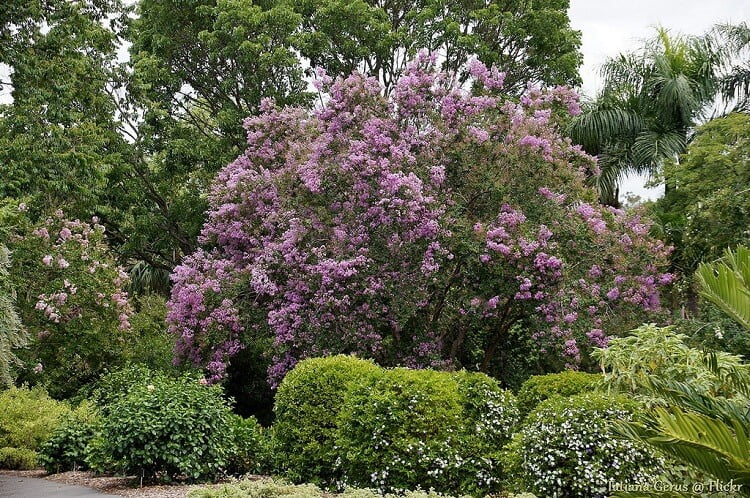
Crape myrtles are flowering shrubs and trees in the genus Lagerstroemia. Their summer flowers, bark and varied growth habits make them useful landscape plants where the climate suits the particular selection. The most important choice is mature size: a dwarf shrub and a large tree cannot be managed as though they are the same plant.
Choose the Right Species and Cultivar
The botanical name identifies the plant group; a cultivar name identifies a selected form. Compare both on the nursery label, along with expected height, spread and local hardiness.
- Common crape myrtle, Lagerstroemia indica: a widely grown species with many garden selections and flower colors.
- Japanese crape myrtle: often listed as L. fauriei, or L. subcostata var. fauriei. It is associated with attractive bark and contributes to many garden hybrids.
- Giant crape myrtle, L. speciosa: a much larger, warm-climate tree. It is not interchangeable with a compact garden selection.
The NC State plant profile illustrates this range, from miniature shrubs to substantial trees. Check a cultivar’s stated size rather than relying on flower color to tell you how large it will grow.

Where to Plant
Choose a sunny location with enough room for the canopy and roots. Shade can limit flowering. Keep a tree-sized selection away from overhead wires, tight spaces beside buildings and places where annual cutting would be needed just to maintain access.
A shrub form can be a border plant; a tree form can provide a focal point. Place it where flowers and peeling bark can be appreciated without crowding a doorway. Check local winter performance: a plant surviving as regrowth from the base is a different landscape result from a persistent tree canopy.
Planting and Establishment
Use the root ball and visible root flare to determine planting depth, not a standard deep hole. Prepare adequate width, set the tree upright and avoid covering the trunk base with soil. Water the root ball and surrounding planting area thoroughly after planting.
During establishment, check moisture rather than watering automatically once a week. Heat, soil, rainfall and root-ball size affect the interval. Water should reach the roots without leaving them continually saturated. Mulch the surrounding soil and keep mulch clear of the trunk.
Established plants may tolerate periods of drought, but that is not a promise of good flowering without water in every climate. Avoid using wilt or poor growth as an automatic signal to add fertilizer: first check moisture, drainage, roots and light.

Prune for Structure, Not to Force a Small Size
Crape myrtles flower on new growth and can flower well without annual pruning. Clemson Extension’s pruning guide explains why routine topping spoils their natural form. Cutting every trunk back to the same height each year is not a requirement for blooms.
Where pruning is needed, remove damaged or rubbing branches and make selective cuts appropriate to the plant’s form. Routine structural work is generally done while dormant, before new growth. Do not strip the lower branches from every shrub to a fixed height: a shrub and a multi-stemmed tree have different intended shapes.
Removing reachable spent flower clusters is optional. Do not climb or overreach to deadhead a mature tree. If a plant repeatedly obstructs the space, reconsider the selection or get advice on selective reduction rather than depending on severe yearly cuts.
Feeding and Flowering
Use soil-test results and local recommendations to decide whether fertilizer is needed. A fixed annual dose of high-nitrogen fertilizer is not a universal care rule. Excess leafy growth is not the same as improved flowering.
For a tree with few flowers, record hours of sun, recent cold damage, pruning history and any lawn fertilizer reaching its roots. Also allow for the selection’s normal flowering season. A plant that blooms later than its neighbor is not necessarily unhealthy.
Recognize Problems Before Treating Them
Clemson’s disease and insect guide covers powdery mildew, leaf spots and sap-feeding pests. Resistant cultivars can reduce some problems, but resistance is not immunity.
- Black sooty coating: investigate honeydew-producing insects such as aphids or scale. Treating the coating alone does not identify the cause.
- White powdery growth or spotted leaves: obtain a diagnosis and review airflow, cultivar susceptibility and conditions before choosing a product.
- Poor growth or dieback: check planting depth, moisture, winter injury and roots as well as pests.
Do not assume any insecticide or fungicide will cure every symptom. If treatment is warranted, use a product labeled for the identified problem and site, following local guidance and the label. A healthy tree in a suitable space is a better starting point than routine spraying.
Image source: 1