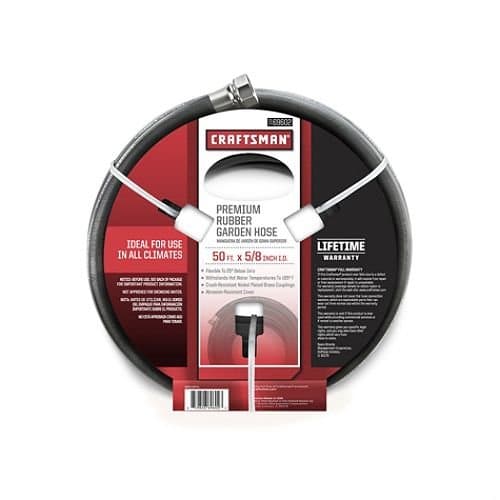
A Craftsman Premium Rubber Garden Hose can be worth considering when you want a conventional hose rather than an expanding fabric design. But the product name alone does not establish its weight, country of manufacture or warranty. Identify the exact model and package before comparing an older example with a current Craftsman hose.
Do not mix old and current models
The earlier review described a 50-foot rubber hose without documenting a model number. That is not enough to transfer every specification to a hose now offered under a similar name. Look for a model number on the packaging or purchase record, and compare the length, inside diameter and coupling design.
For example, Craftsman’s current CMXMHHF5850L product page identifies a 50-foot rubber hose with a five-year limited warranty. That example demonstrates why an older blanket “lifetime warranty” promise is unreliable; it does not prove the older hose and this model are identical.
What rubber construction means for your choice
Consider a conventional rubber hose if compact expansion is less important than having a familiar, fixed-length watering line. Assess the hose when extended and when coiled. Storage space, the route around beds and the effort required to move a water-filled hose matter as much as its material label.
This page has no controlled durability or kink test. It cannot substantiate “the last hose you will ever need,” “will not leak,” or a guarantee that it survives years of exposure. Rubber construction does not make washers, fittings or the hose body immune to damage.
Measure the actual route to the farthest watering point. Buying extra length you rarely use means more hose to drag and store. Conversely, a hose that barely reaches may encourage pulling on the fittings. Leave a practical routing allowance without choosing length solely because a larger coil looks like better value.
Read the applicable warranty
Craftsman’s warranty information distinguishes product categories and terms. Check the package and ask support which policy applies to your exact purchase, especially for old stock or a secondhand hose. Keep proof of purchase and the product identification.
A warranty is a set of conditions for a remedy, not a measurement of expected service life. It also differs from a retailer’s return window. Confirm who handles a claim and what evidence is required before relying on warranty language to justify the price.
Water use and condition checks
Do not assume this older, unidentified hose is suitable for drinking water. For filling potable-water containers or an RV fresh-water tank, select a hose explicitly labeled for that purpose. Neither a rubber description nor the appearance of its metal fittings establishes that suitability.
Before use, inspect the washers, threads and hose-to-fitting joints. A missing washer and a damaged hose body require different remedies. Follow the manufacturer’s maintenance instructions instead of repeatedly tightening a leaking connection or treating thread tape as a cure for every leak.
Follow the exact product’s temperature, pressure and storage limits. Cold-weather flexibility, when documented, does not mean a hose can safely be left full of freezing water. Avoid dragging it across sharp edges or using it as a pulling handle for equipment.
Purchase verdict
Choose on documented specifications, manageable working weight and the total cost of a complete usable hose. The older review’s customer counts and quotations do not provide a reliable present-day failure rate. This is a buying assessment, not a hands-on test or an unconditional durability endorsement.
For help comparing length, handling and intended use, see our garden-hose buying guide.