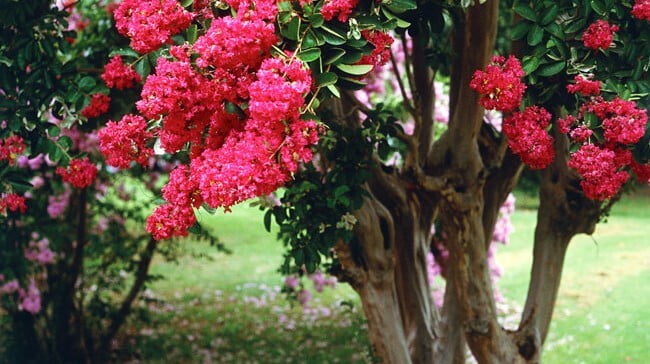
Crepe myrtle, also spelled crape myrtle, does not need heavy annual pruning to flower. Begin with the plant’s natural form and remove only growth that creates a specific problem. A cultivar that fits its site usually needs much less correction than a tree repeatedly cut down to fit a small space.
Decide whether pruning is needed
Look for dead or damaged wood, branches that rub, unwanted basal shoots and clearance problems. Do not shorten every branch simply because neighboring trees have been topped. Clemson Extension explains that these plants can flower well without pruning and are available in sizes ranging from dwarf shrubs to large trees. Six feet is not a universal mature height.
Stand back and identify the cuts you actually need. A branch growing horizontally is not automatically wrong, and every inward-growing twig does not require removal. Preserve a balanced framework rather than forcing a particular shape from a photograph.
Choose the timing
For routine shaping, late winter or early spring before new growth is a useful window. Flowers develop on new growth. Dead or damaged branches should be assessed when found rather than ignored until a calendar date. Optional removal of spent flowers on a small, accessible plant may encourage another flush, but it is not essential maintenance for a tall tree.
Use tools suited to the cut
Hand pruners suit small growth; loppers or a pruning saw may be needed for larger branches. Work within the tool’s capacity and keep it maintained. Do not use extra leverage to force a tool through wood it cannot cut cleanly.
Keep stable footing and the work area clear. Large limbs, overhead hazards, power lines and work requiring climbing belong with a qualified professional. An extendable tool does not automatically make a high cut safe.
Make selective cuts
Remove unwanted basal shoots without injuring the main trunks. For a tree form, develop the framework gradually; a shrub form does not need to be stripped of all lower growth. If two branches rub, assess which removal best preserves the structure rather than cutting both by default.
When removing a branch, protect the branch collar rather than cutting flush against the trunk or leaving a long stub. Clemson’s general tree-pruning guide explains the placement and purpose of pruning cuts. Stop and reassess the overall form between cuts; it is easy to remove more living canopy than intended when concentrating on one section.
Avoid topping as an annual routine
Cutting main stems back to the same height creates an artificial framework and repeated maintenance. It is not necessary simply because the plant flowers on new wood. If the tree repeatedly outgrows the space, consider whether a smaller cultivar or a different location would solve the underlying problem.
A previously topped tree needs an individual recovery plan. Do not remove all replacement growth at once or assume the same treatment suits every damaged specimen. Ask a local extension service or arborist to assess the structure and practical options.
Leave accessible maintenance accessible
Seed heads do not need to be removed to ensure next season’s flowers. If they are beyond comfortable reach, leave them. Keep records of any substantial pruning and watch how the plant responds before scheduling more. The aim is a healthy plant that fits the garden, with enough natural structure to enjoy its bark, canopy and seasonal flowers.