Choose a landscaping tree for its mature size and the conditions in your yard before choosing it for its flowers or autumn color. These five trees offer different effects, but none is suitable for every climate or planting space. Check local recommendations, overhead lines, underground utilities, soil drainage and the room available for a full-grown canopy.
A nursery tree can look comfortably small beside a house while eventually becoming much too large. Compare the botanical name and cultivar on the label with a reliable mature-size description. If your aim is a compact accent tree, do not substitute a large shade tree simply because both have attractive foliage.
1. Cornelian cherry dogwood
Cornelian cherry dogwood, Cornus mas, is a small tree or large shrub with yellow flowers in late winter or early spring. Its red fruits develop later, generally in summer; they are not red autumn flowers. Fall leaf color is variable rather than a dependable red display.
It can suit a garden that needs an early-season focal point and has room for a spreading, often multistemmed shape. NC State’s profile describes a typical size of about 15–25 feet tall and 15–20 feet wide. ‘Cherokee Sunset’ is a cultivar of flowering dogwood, Cornus florida, not another color form of Cornelian cherry. Check which species you are buying.

2. Sugar maple
Sugar maple, Acer saccharum, is a large shade tree valued for autumn foliage that can include yellow, orange and red. It needs the space of a shade tree, including room for its roots and canopy, rather than a narrow foundation bed.
It is not a tree for almost any soil. Assess drainage, summer conditions, compaction and exposure to road salt before choosing it. A favorable site matters more than a promise of low maintenance. Use the NC State sugar maple profile and regional advice to decide whether it fits your climate.

3. Saucer magnolia
Saucer magnolia, Magnolia × soulangeana, provides conspicuous pink, white or purplish flowers, depending on the cultivar. It can be an attractive spring specimen where there is room for its spreading form. It still becomes a substantial tree; “ornamental” does not mean it can fit anywhere.
Early flowers can be damaged by late frost. Choose an appropriate site and cultivar rather than expecting an equally good display every spring. NC State’s saucer magnolia profile provides its site and size requirements. Avoid placing it where future pruning would continually remove the shape you selected it for.

4. Northern red oak
Northern red oak, Quercus rubra, is a large deciduous tree for a yard with adequate long-term space. Its acorns support wildlife, and its canopy can provide shade. Autumn color varies; a brilliant red display is not guaranteed at every site or every year.
Plan for acorn and leaf cleanup if it stands near a patio or driveway. Do not select it on a guaranteed lifespan claim: site quality, health and care affect longevity. Consult the NC State red oak profile when comparing it with other locally suitable oaks.

5. Colorado blue spruce
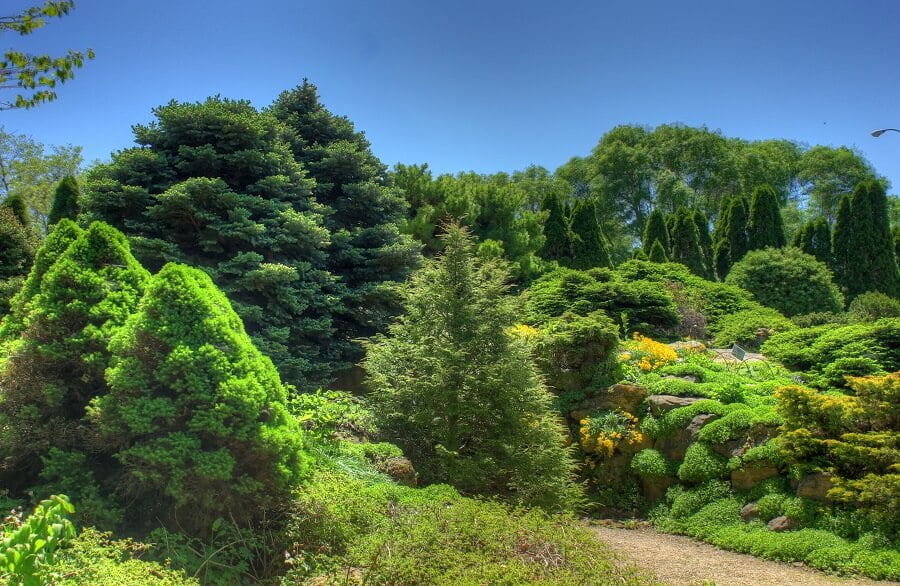
Colorado blue spruce, Picea pungens, offers an evergreen outline and foliage that varies from green to blue-gray. Check the exact cultivar, since size and color differ. A full-size tree needs much more room than a compact selection.
It does not thrive everywhere. Humid conditions and disease pressure can make it a poor choice in some regions. University of Minnesota guidance on needle cast explains a common problem, while NC State’s species profile describes its growing requirements. Ask about locally adapted evergreen alternatives before buying.

Put your shortlist into a landscape plan
Mark the expected canopy on a simple yard plan, then consider shade, access and seasonal cleanup. Choose the tree first for the site, and use nearby planting and seating to complement it. Our ideas for landscaping with trees cover the next step: arranging paths, seating, structures and planting around them.