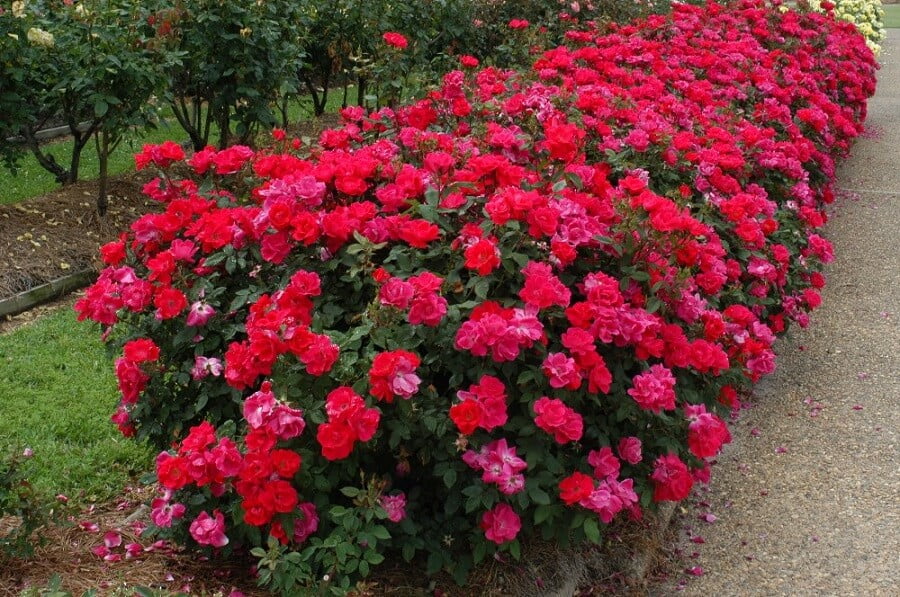
Knock Out roses can provide repeat color with less routine deadheading than some other roses. They still need a suitable site, water during establishment and monitoring for problems. Their fragrance, size and cold tolerance depend on the selection; they are not evergreen, pest-proof shrubs that flower through every winter.
1. A choice of flower forms and colors
The Knock Out family includes different selections, so compare the actual cultivar rather than buying by the family name alone. Look at flower form, mature dimensions and the plant label’s climate guidance. A photograph of an individual bloom does not show how much space the shrub will occupy.
2. Repeat flowering during the growing season
Expect flushes of flowers, with quieter intervals between them, rather than an identical display every day. The breeder describes repeat bloom until the first hard frost. Winter hardiness is the ability to survive cold, not a promise of winter flowers.
3. Fragrance in selected varieties
Do not assume every Knock Out rose has a strong perfume. The breeder’s FAQ identifies Sunny Knock Out and White Knock Out as fragrant selections. If scent is your main reason for planting, check the exact variety and, where possible, smell a flowering specimen before buying.
4. A manageable shrub form
These are landscape shrubs, not automatically tiny border plants. Check mature width as well as height and leave space for access around the planting. A shrub beside a narrow path must fit without requiring constant clipping.
5. A role in sunny mixed borders
The breeder’s planting instructions call for six to eight hours of sunlight. Assess the site when nearby trees are in leaf. A bed that is bright in early spring can become shaded later, reducing its suitability.
6. Less routine deadheading
The flowers are described as self-cleaning, so removing each spent bloom is not necessary for the same purpose as with some roses. This does not mean diseased leaves, dead canes or broken branches take care of themselves.
7. Useful color in repeated groups
A repeated cultivar can make a border feel connected. Lay out the mature plant widths before buying a group, and avoid crowding them together for an instant full appearance. Leave enough room to inspect individual plants and work around them.
8. Some disease resistance, with limits
Resistance is not immunity. Black spot and powdery mildew can still occur, and insects may feed on leaves or flowers. Identify symptoms before choosing a treatment; a rose does not need a preventive spray simply because a pest is present nearby.
9. Foliage that supports the flower display
Healthy leaves are part of the shrub’s appeal, but their appearance can change with weather, season and stress. Do not expect permanent dark-green foliage all year. When leaves decline, examine watering, drainage and symptoms rather than immediately adding fertilizer.
10. Flowers for informal arrangements
You can cut a few stems for a small arrangement without treating the shrub as a specialist cut-flower crop. Choose the flower form you enjoy and leave plenty of healthy growth on the plant. Vase performance will vary; a landscape rose does not come with a guaranteed vase life.
11. A simple establishment routine
Plant at the appropriate depth, water thoroughly and check moisture regularly while roots establish, following the breeder’s instructions. Do not leave a newly planted shrub to dry out because an established rose is described as drought tolerant. Adjust watering to rainfall, soil and heat.
12. Maintenance you can plan
Schedule inspection and pruning around your cultivar and local season. Avoid treating an exact pruning height as a rule for every rose bearing the brand name, including miniature and tree forms. Remove damaged growth as needed and consult the selection’s care instructions for major pruning.
13. Container possibilities

Choose a cultivar and pot that suit one another, with drainage and space for root growth. Containers need closer moisture checks and a winter plan appropriate to your climate. Do not assume a heated living room is the right seasonal home for every outdoor rose.
Rose rosette disease needs a separate response
University of Maryland Extension explains that rose rosette is a viral disease spread primarily by microscopic mites. It affects different roses, including cultivated and wild plants; it is not simply the result of neglecting a Knock Out rose.
Watch for abnormal crowded shoots, distorted leaves or flowers, and unusually dense thorn growth. Red new growth by itself is not a diagnosis. Seek identification help if symptoms are suspicious. There is no cure for an infected plant, and cutting off visibly affected shoots does not remove a systemic infection; confirmed infected plants should be removed promptly.
Choose Knock Out roses because their flowering habit and mature size suit your garden, while allowing time for basic care. They can be a practical option without being the right rose for every site.
Image credits: 3.