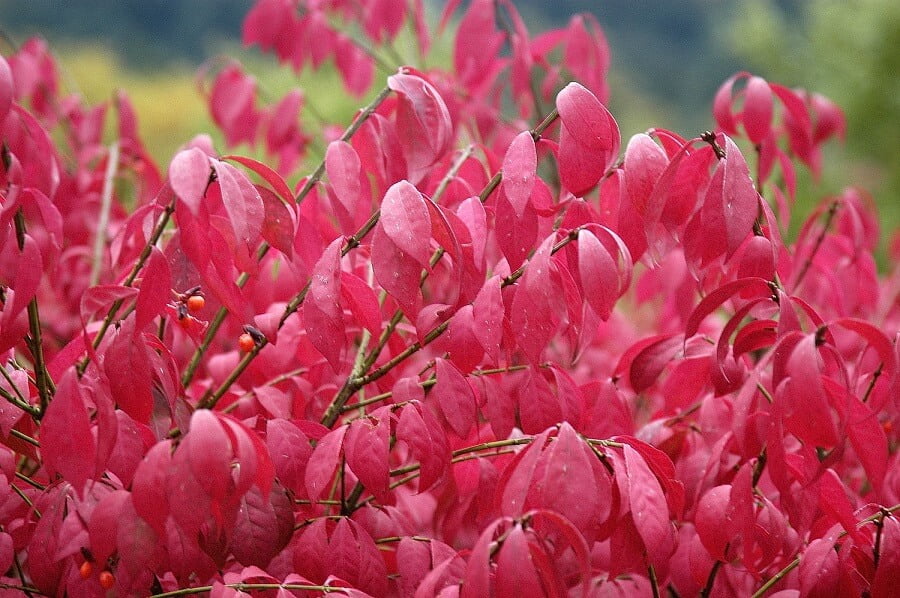
Before planting burning bush (Euonymus alatus), check its local invasive status and any restrictions. Its red autumn foliage is attractive, but the shrub can escape gardens and displace native vegetation. Where it is invasive or restricted, choose an alternative and consider replacing an existing plant rather than propagating it.
1. Identify the shrub and check local guidance
Burning bush is a deciduous shrub with opposite leaves and characteristic corky ridges on many stems. It can become a substantial shrub, so a small nursery pot does not predict its final size. NC State Extension’s plant profile provides identifying features and growing information.
Rules vary by location. Minnesota Extension lists it as a restricted noxious weed prohibited from sale, propagation and transport in that state. Maryland Extension also advises against planting it and describes its prohibited status there. Check your own jurisdiction’s current list rather than assuming a retailer’s listing means it is suitable locally.
2. Decide whether to keep it or replace it
Birds can disperse the seeds beyond the garden, and a neatly clipped hedge can still be an ecological problem. Being sold as a compact cultivar does not by itself establish that a plant is noninvasive. For a new planting, compare locally suitable alternatives with attractive autumn foliage, such as chokeberry, fothergilla or Virginia sweetspire.
Match the replacement to sunlight, moisture and mature size. Do not transfer an unwanted burning bush to another garden where it may spread or where movement is restricted. Ask local Extension staff about removal and disposal appropriate to your location.
3. Understand the site of an existing plant

Burning bush tolerates sun and shade, though autumn color varies with conditions. It does not need to be repeatedly fertilized or cut into a tight shape to produce its seasonal change. Check whether the site is waterlogged, excessively dry or too confined before attributing poor growth to a pest.
Where keeping the shrub is permitted and appropriate, allow room for its mature branches. Planting depth and root condition matter more than digging to an arbitrary multiple of the nursery container. Avoid burying the root flare or piling soil against established stems.
4. Check moisture before watering
During establishment or prolonged dry weather, inspect soil moisture in the root zone. Water slowly enough to soak in, then reassess rather than repeating a fixed weekly schedule. Do not deliberately let the entire root ball dry completely, and do not keep already wet ground saturated.
A shallow organic mulch can help manage moisture, but keep it clear of stems and avoid adding layer after layer. Fresh manure or an arbitrary mixture of waste materials is not a necessary mulch treatment.
5. Avoid automatic fertilizer applications
Do not apply “half a cup” of an unspecified fertilizer: products differ greatly in concentration and application method. Use a soil test and a diagnosis of any growth problem before feeding. A shrub that has drainage damage will not be repaired by fertilizer spikes.
Where replacement is the preferred management choice, there is little reason to encourage additional growth before removal. Spend that effort preparing an appropriate site for the replacement.
6. Identify pests accurately
Look closely at leaf undersides, twigs and the pattern of damage. Mites and scale insects require different identification and management; a red or green smear on paper is not a reliable way to separate all beneficial and harmful mites. Photograph symptoms or submit a sample to a local diagnostic service when needed.
Do not apply insecticidal soap as a universal cure. If treatment is warranted, the product must be labeled for the plant and target pest, and applied at an effective life stage according to its directions. Avoid unnecessary spraying of beneficial organisms.
7. Prune conservatively or plan removal
Do not routinely cut the whole shrub to three inches and expect guaranteed recovery by the end of the season. Remove dead, broken or interfering growth as appropriate; major rejuvenation depends on plant health and the intended management goal. Repeated severe pruning is a poor solution to a shrub that has outgrown its location.
If removing an invasive plant, plan for resprouts and seedlings rather than assuming one cut has finished the job. Use local invasive-plant guidance, keep seed-bearing waste contained and follow local disposal requirements. Replant with a suitable alternative and monitor the area afterward.
Image credits: 2.