

Flowering shrubs can add structure, seasonal flowers, fruit and foliage to a landscape. The best choice depends on your climate, soil and available room. These six options offer different kinds of interest; they are not interchangeable, and most do not keep their leaves throughout winter.
Before planting, check the mature width as carefully as the height. Leave room beside paths and windows, and choose a shrub that fits naturally rather than relying on frequent hard pruning. A mix of flowering seasons can provide a longer display than several plants that peak at the same time.
1. Winterberry holly: fruit on bare winter branches

Ilex verticillata is a deciduous holly whose red fruit can provide color after the leaves fall. Its flowers are less showy than the berries, so use it where the winter display will be visible from a window or path. Fruit develops and colors before winter; it is not a crop of new winter flowers.
Female plants need a compatible male with overlapping bloom time for good fruit production. Choose the pairing by cultivar, not merely by buying any male holly. Winterberry favors acidic, moist soil, and mature size varies considerably. The NC State plant profile lists pollinizer examples and site requirements.
Do not treat decorative berries as human food. Allow enough space for the selected plants without placing fruit where young children are likely to sample it.
2. Black Lace elderberry: dark foliage and early-summer flowers

Black Lace, Sambucus nigra ‘Eva’, is valued for finely divided purple-black foliage. Pink flowers appear in early summer, rather than reliably waiting until late summer. It makes a dramatic backdrop or specimen where there is room for a large shrub.
Proven Winners lists a mature size of about six to eight feet and notes that foliage color can be greener in hot climates. A compatible elderberry is needed for berry production. The breeder recommends pruning after flowering when preserving the floral display is important.
Hard cutting to produce fresh foliage is a different management choice and can sacrifice flowers. Do not cut it to knee height every winter while expecting the same bloom performance. Keep ornamental elderberry parts away from pets and children; this landscape selection should not be treated as an unrestricted edible plant.
3. Brandywine viburnum: a late-season fruit display

Brandywine, Viburnum nudum ‘Bulk’, combines white flowers, glossy leaves and clusters of fruit that change color. Its pink and blue fruit is a late-summer-to-autumn feature, not something that first ripens only when winter arrives. The foliage can turn maroon in fall.
Proven Winners describes Brandywine as able to fruit without a second pollinator, with heavier production possible near another compatible V. nudum, such as Winterthur. That cultivar-specific point should not be generalized to every viburnum.
Give it space in a mixed border and avoid shearing away the flower clusters if fruit is the reason you planted it. Check local suitability and the current plant label for mature size and exposure before choosing its position.
4. Panicle hydrangea: summer flowers and useful scale choices

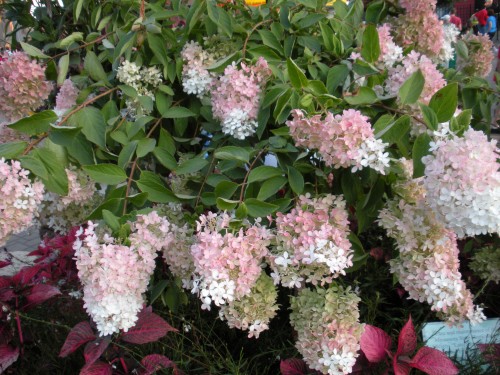
Hydrangea paniculata has cone-shaped flower clusters, with colors and flowering times that vary among cultivars. Many begin pale and develop pink tones as they age. Flower color alone does not tell you how tall a plant will become.
Large cultivars can anchor a border; compact selections can suit smaller spaces. Compare the actual mature dimensions of Little Lime, Little Quick Fire or any other selection rather than assuming the word “little” guarantees the same size.
The NC State profile describes panicle hydrangea’s growing requirements. It tolerates more sun than some other hydrangeas, but still needs suitable moisture and may benefit from afternoon protection in hot locations. It flowers on new growth; pruning decisions should reflect that rather than a rule copied from bigleaf hydrangeas.
5. Mellow Yellow spirea: golden foliage and spring flowers

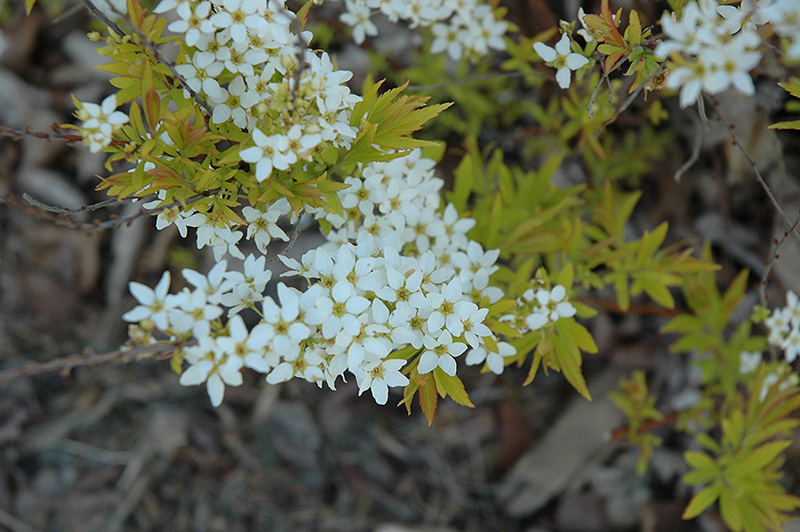
Spiraea thunbergii ‘Ogon’, often sold as Mellow Yellow, has narrow yellow-toned leaves and arching growth. Small white spring flowers are followed by foliage that changes through the growing season. It is deciduous, so do not expect the same leaf display in winter.
NC State recommends pruning after flowering when shaping is needed. Its profile describes golden spring foliage, greener tones later and orange tones in autumn. Calendar dates vary with climate; a fixed late-March bloom promise is inappropriate for every garden.
It can be relatively low maintenance in the right place, but is not immune to insects or disease. Check local advice on suitability and spreading behavior, and leave room for the arching branches instead of clipping them into a tight ball.
6. Oleander: a warm-climate option with a serious limitation

Oleander, Nerium oleander, can provide flowers and evergreen structure in suitable warm climates. Cultivars differ in size and flower color. Its use on roadsides does not make it suitable for every home garden.
NC State identifies oleander as highly poisonous, fresh or dry. Plant parts and sap require care; avoid it where children, pets or livestock may ingest material. Wear gloves when handling it, keep clippings away from animals, and do not burn them. Where accidental contact or ingestion is a realistic concern, choose another shrub.
Build the planting around the site
Choose two or three roles first: a winter focal point, summer flowers, screening or a foliage contrast. Match those roles with locally suitable plants and leave space for their mature forms. Water during establishment, mulch appropriately and prune according to the species and flowering habit. This is more effective than buying six attractive shrubs and trying to make them all fit the same conditions.