The best lawn fertilizer is one that supplies the nutrients your grass needs at the right time. Start with your grass type, a soil test and local lawn guidance. A bag labeled organic, multi-nutrient or weed-and-feed is not automatically the right spring choice.
Read the three numbers
The fertilizer grade reports percentages by weight of nitrogen, phosphate and potash, in that order. Nitrogen supports leafy growth, but more growth is not always desirable. Phosphorus and potassium should be selected according to need rather than a promise that a complete fertilizer makes every lawn greener.
Maryland Extension’s fertilizer basics explains the numbers and nutrient sources. A single-nutrient product supplies one primary nutrient; it is not necessarily nitrogen. Organic and synthetic describe sources, while single- and multi-nutrient describe composition, so these are not three mutually exclusive categories.
Check what the lawn actually needs
Tell the soil laboratory that the sample is from a lawn and identify the grass if possible. Use its recommendations for pH and nutrients together with local turf advice. Nitrogen recommendations often depend on the grass and management goals rather than a routine soil nitrogen measurement.
Poor growth can also result from shade, compaction, standing water or unsuitable grass. Fertilizer does not correct those causes. Inspect a struggling patch before feeding the whole yard. Measure the actual lawn area, excluding paths and beds, so a product rate can be applied accurately.
Choose timing for your grass and location
Cool-season and warm-season grasses have different growth cycles. Do not fertilize dormant warm-season turf just because a calendar says spring. Likewise, a large early nitrogen application is not a universal prescription for cool-season lawns.
Follow local guidance and applicable restrictions on nutrient applications. Maryland’s established-lawn guide illustrates how grass type, soil testing and regional rules shape the plan; its local schedule should not be copied worldwide.
Compare release characteristics and cost
Read the analysis and application directions rather than comparing bag size alone. Products with different nutrient concentrations cover different areas at a given nutrient rate. Check how much nitrogen is identified as slow-release and what conditions or watering the product requires.
Organic fertilizers can supply useful nutrients, but their release varies with the product and growing conditions. They are not inherently safe to ingest or harmless around pets, children and water. Keep every fertilizer stored securely and follow its access precautions. More expensive or more concentrated does not automatically mean better suited to your lawn.
Keep weed control a separate decision
Fertilizer feeds grass; it is not a general weed killer. Identify the unwanted plant first, using the common garden weed guide as a starting point. A combination product is appropriate only when both its fertilizer and pesticide components fit your lawn’s needs and timing.
Check the grass species, weed, site and reseeding restrictions on a weed-and-feed label. Do not buy it merely to make a fertilizing trip feel more complete. An ordinary fertilizer and a targeted weed-management plan may fit better.
Apply carefully and reassess
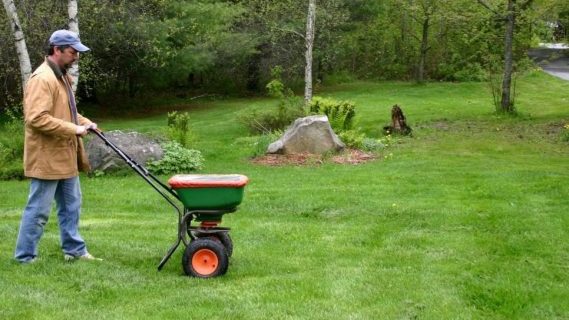
Calibrate the spreader for the product, follow the label and avoid overlapping passes excessively. Keep granules off pavement and out of drains. Do not apply onto frozen or saturated ground or ahead of conditions likely to wash the material away. Water only as the product directions require.
Record what you used, the rate and date. Judge the response over time rather than repeating applications because the lawn is not instantly dark green. The useful result is healthy grass suited to the site, not the fastest possible growth.